Bassein Gas Field — At a Glance
- Discovered: 1976
- Commercial Production: September 1988
- Location: ~80 km northwest of Mumbai, Arabian Sea
- Water Depth: 50–70 metres Initial Gas In Place: ~393 BCM (~11 TCF)
- Peak Production: ~29 MMSCMD
- Major Infrastructure: BPA, BPB, South Bassein–Hazira Trunkline (SBHT), Hazira Gas Processing Complex
- Key Technical Challenge: Sour gas handling (H₂S + CO₂)
- Strategic Role: Fertilizer, power generation, petrochemicals, industrial fuel systems
- Years of Offshore Operations: 37+ years and counting
- Projected Field Life: Up to ~2059
Whenever India’s offshore energy history enters the conversation, attention almost instinctively turns toward Bombay High.
That is understandable.
Discovered in 1974, Bombay High reduced crude import dependence, transformed India’s confidence in offshore exploration, and established ONGC’s Western Offshore Basin as one of the country’s most strategically important hydrocarbon provinces.
Yet while Bombay High became the face of India’s offshore oil success, another field , discovered just two years later in the same waters , quietly built something more complex and arguably more consequential:
India’s offshore gas backbone.
To understand what Bassein represents, it helps to understand the sequence that preceded it.
In 1973, a Japanese-built jack-up drilling rig called Sagar Samrat entered the Arabian Sea. In 1974, it drilled India’s first offshore well and went on to support multiple offshore discoveries across its long service life.
Sagar Samrat gave India its offshore drilling confidence.
Bombay High gave India its offshore oil confidence.
But both achievements were fundamentally about finding and extracting hydrocarbons from beneath the seabed.
Bassein posed a different engineering question entirely.
Not whether India could drill offshore.
But whether India could build the engineering systems — offshore processing platforms, sour gas handling capability, subsea evacuation corridors, and onshore integration infrastructure — needed to sustain offshore gas production safely and reliably for decades.
That is a categorically different capability.
And Bassein is where ONGC was forced to build it.
If Sagar Samrat represented India’s confidence in offshore drilling, and Bombay High represented India’s offshore oil confidence, then Bassein represented India learning how to sustain offshore gas production at scale.
That distinction matters.
Because offshore gas is not simply about extraction.
It is about reliability, continuity, process safety, and long-term engineering discipline.
The story of Bassein begins in 1976, when ONGC drilled into a Middle Eocene limestone reservoir, roughly 80 kilometres northwest of Mumbai, in 50–70 metres of Arabian Sea water.
What they found was extraordinary.
The field carried an estimated 393 billion cubic metres (BCM) of gas in place , roughly 11 trillion cubic feet (TCF) , making Bassein one of India’s largest offshore gas discoveries and placing it among the more significant offshore gas accumulations globally at the time.
For a country still strengthening domestic energy security, this was not merely another offshore hydrocarbon find.
It represented the possibility of building a long-term domestic gas ecosystem.
But offshore discoveries only tell part of the story.
Finding hydrocarbons beneath the seabed is one challenge.
Producing them safely, processing them reliably, and transporting them economically for decades is something entirely different.
And in Bassein’s case, that challenge was far more demanding than many realize.
Despite discovery in 1976, commercial production did not begin until September 1988.
Twelve years later.
That gap deserves more attention than it usually receives.
Because it tells the real engineering story of Bassein.
The gas at Bassein was sour gas.
It contained significant concentrations of hydrogen sulphide (H₂S) and carbon dioxide (CO₂).
For people outside the industry, that may sound like a technical detail.
For offshore engineers, it changes everything.
The simultaneous presence of H₂S and CO₂ fundamentally alters metallurgy, processing philosophy, corrosion management, inspection strategy, and safety architecture.
Hydrogen sulphide introduces the risk of sulphide stress cracking, where carbon steel can fail under tensile stress without obvious warning signs.
CO₂ creates another challenge through carbonic acid corrosion, which attacks internal pipe surfaces when produced water is present.
Managing both simultaneously in an offshore environment is far from straightforward.
It means:
- Conventional materials may no longer be suitable
- Sour service metallurgy becomes essential
- Pipeline design philosophy changes
- Shutdown logic becomes stricter
- Emergency systems become more critical
- Inspection intervals become more aggressive
- Integrity management becomes central to operations
This meant ONGC could not simply drill wells and begin flowing gas.
India first had to build offshore sour gas engineering capability at scale.
In many ways, Bassein became one of ONGC’s earliest and most important offshore sour gas handling challenges, forcing the organization to mature beyond drilling into materials engineering, process safety, corrosion science, integrity management, and long-term offshore operations.
Bassein’s success was not simply geological.
It was engineering-led.
Hydrocarbons beneath the seabed have little value unless infrastructure exists to safely move them into the economy.
For Bassein, this meant building much more than offshore wells.
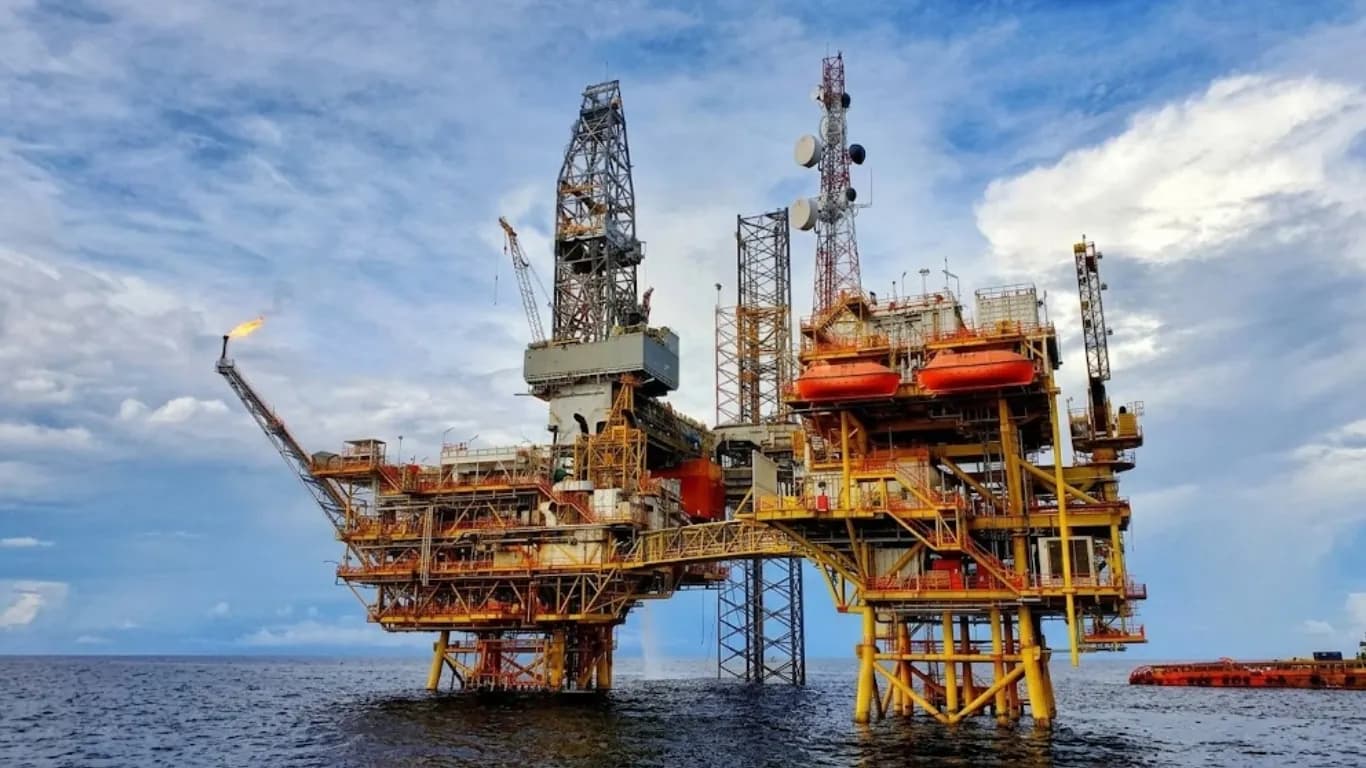
ONGC had to establish offshore gas processing capability through Bassein Platform A (BPA) and Bassein Platform B (BPB), which became operational during the late 1980s.
These were not ordinary production platforms.
They became integrated offshore gas processing facilities capable of handling sour gas before transportation.
But platforms alone were not enough.
The gas had to move.
This led to the development of the South Bassein–Hazira Trunkline (SBHT) — one of India’s most strategically important offshore gas evacuation corridors.
The first 36-inch trunkline, stretching nearly 230 kilometres, connected offshore production to the Hazira Gas Processing Complex in Gujarat.
As production expanded, a second 42-inch pipeline was commissioned to handle increasing gas volumes.
Hazira itself evolved into one of India’s most important gas-processing hubs, capable of processing nearly 45–52.5 MMSCMD of gas.
This offshore-to-onshore integration quietly became one of the most important links in India’s industrial economy.
Without it, Bassein would have remained simply another offshore discovery.
Recommended by LinkedIn
Once processed, Bassein gas entered sectors that would shape India’s growth for decades.
At various stages, Bassein gas supported:
- 9 power plants
- 7 fertilizer units
- 2 refineries
- 2 petrochemical plants
At its peak, Bassein contributed approximately 43% of ONGC’s total gas production, while Western Offshore assets collectively accounted for a substantial portion of India’s hydrocarbon output.
This is perhaps where Bassein quietly changed India.
The gas that powered fertilizer plants.
The gas that fed turbines.
The gas that supported petrochemical expansion.
The gas that helped industrial clusters operate reliably.
Most people never saw it.
Industry depended on it.
When Bassein entered commercial production in 1988, engineering models projected:
- Peak gas production of around 20 MMSCMD
- Lifetime cumulative production of approximately 180 BCM
- Natural decline beginning around 2010
Bassein exceeded nearly every prediction.
By 2011, cumulative production had crossed 200 BCM.
Peak output reached approximately 29 MMSCMD, significantly above original expectations.
By 2017, cumulative production had crossed nearly 248 BCM, well beyond original lifetime assumptions.
This is an important reminder that offshore success is rarely defined by discovery alone.
Long-term engineering discipline, brownfield management, and sustained intervention matter equally.
Over time, Bassein evolved far beyond a standalone field.
The broader Bassein & Satellite Asset expanded across nearly 7,300 square kilometres, incorporating:
- South Bassein
- Vasai East
- Daman fields
- C-Series fields
- NBP (D1)
- B-193 super sour gas development
The inclusion of B-193 introduced another level of offshore complexity because of its high H₂S content, further strengthening ONGC’s sour gas engineering capability.
37 Years Offshore: What Sustaining Sour Gas Really Takes
Commercial production began in 1988.
By 2026, key parts of the Bassein ecosystem have supported nearly 37+ years of offshore operations.
For an offshore sour gas system operating in a highly corrosive marine environment, that is an engineering achievement in itself.
Because offshore maturity introduces an entirely different challenge.
The conversation gradually shifts from exploration toward:
- Flow assurance
- Compression efficiency
- Pipeline integrity
- Corrosion management
- Rotating equipment reliability
- Brownfield modernization
- Control system migration
- Risk-based inspection
Many offshore facilities commissioned during the late 1980s were never designed for operating lives this long.
Legacy PLC and DCS systems approach obsolescence.
Rotating equipment accumulates decades of operating hours.
Pipeline integrity programs become increasingly demanding.
Corrosion under insulation (CUI), topside fatigue, gas system erosion, and integrity monitoring become critical.
In many ways, Bassein forced ONGC to evolve.
Not merely as a drilling organization.
But as an offshore integrity engineering organization.
Because mature offshore systems eventually test something different.
Not exploration capability.
But engineering discipline.
What Bassein Means for India’s Offshore Future
The next chapter of the Bassein story may not be about production growth.
It may increasingly become about engineering stewardship.
How effectively can mature offshore infrastructure be modernized?
How intelligently can brownfield systems be upgraded?
How reliably can aging sour gas systems continue operating without compromising safety or uptime?
These are not future questions anymore.
They are today’s offshore realities.
And Bassein is already forcing those conversations.
The legacy of Bassein is not simply that India discovered a giant offshore gas field in 1976.
Every offshore discovery carries geological importance.
The real legacy lies in what followed.
Building India’s offshore sour gas capability.
Creating one of the country’s most important offshore gas evacuation systems.
Connecting offshore production to industrial growth.
Extending field life far beyond original assumptions.
And proving that offshore infrastructure — if engineered correctly, modernized intelligently, and maintained with discipline — can continue supporting national growth for decades.
Sagar Samrat showed India it could drill offshore.
Bombay High showed India it had oil.
Bassein showed India something harder to build — the ability to sustain offshore gas production at scale.
That may ultimately be its most important contribution.
For professionals who have worked in Western Offshore operations, South Bassein facilities, Hazira processing, offshore gas systems, or ONGC programs — what part of the Bassein story do you think deserves more attention?
Happy Reading!