
Lifecycle & Execution
Lifecycle & Obsolescence Support
Lifecycle support manages the period between commissioning and replacement. SMEC helps identify obsolete or unsupported hardware, spares exposure, software dependencies and failure risk, then defines a practical keep/repair/retrofit/migrate strategy.
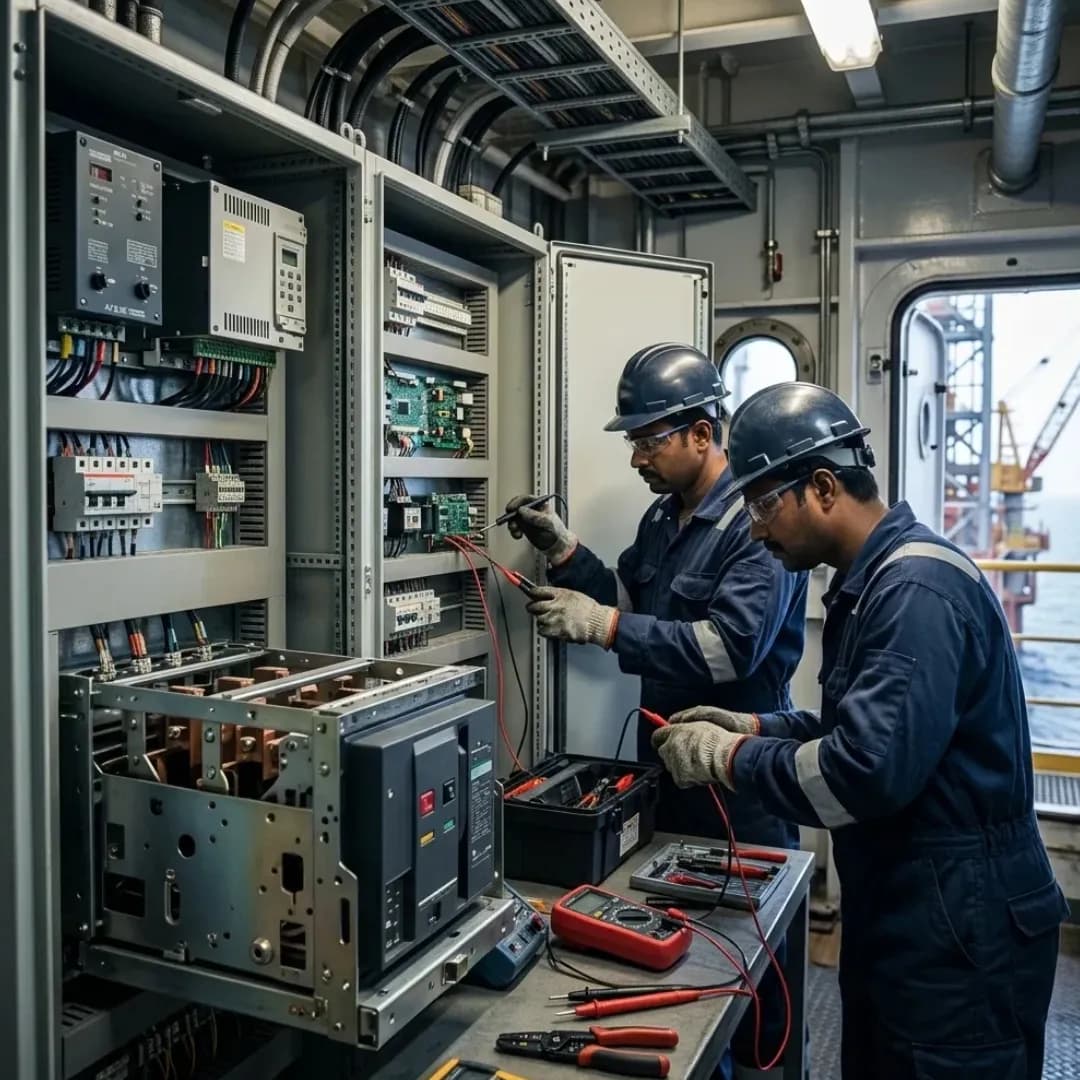
Obsolescence & Retrofit
Before Replacing the Asset, Understand What Can Be Saved.
When a control card fails or a drive becomes unsupported, replacing an entire machine is not always the best engineering answer. The challenge is identifying what can be retained, repaired, refurbished or modernised while protecting the original machine functions and operating interfaces.
SMEC supports legacy PLC, drive, industrial-electronics, marine PMS/IAS and drilling-control lifecycle work—from assessment and troubleshooting to staged retrofit and recommissioning.
Explore engineering capabilities
Typical scope
- Installed-base register
- OEM lifecycle/status review
- Critical-spares assessment
- Repair feasibility
- Form-fit-function replacement review
- Migration roadmap
- Emergency troubleshooting and planned retrofit
Control Obsolescence
Scope can include Obsolete OEM PLCs, HMI/SCADA, Firmware and backups and related interfaces. Equipment selection, engineering responsibilities and testing are defined against the project specification.
- Obsolete OEM PLCs
- HMI/SCADA
- Firmware and backups
- I/O compatibility
Drives & Electrical
Scope can include VFD repair/replacement, MCC, Switchgear controls and related interfaces. Equipment selection, engineering responsibilities and testing are defined against the project specification.
- VFD repair/replacement
- MCC
- Switchgear controls
- Generator PMS
- Protection
Industrial Electronics
Scope can include PCBs and control cards, RTUs, Instruments and related interfaces. Equipment selection, engineering responsibilities and testing are defined against the project specification.
- PCBs and control cards
- RTUs
- Instruments
- Alarm electronics
- Spares
Marine & Drilling
Scope can include Marine PMS/IAS, Engine remote control, Rig SCR/VFD and related interfaces. Equipment selection, engineering responsibilities and testing are defined against the project specification.
- Marine PMS/IAS
- Engine remote control
- Rig SCR/VFD
- Winch and jacking
Lifecycle & Cutover
Scope can include Installed-base assessment, Repair-versus-replace, Phased migration and related interfaces. Equipment selection, engineering responsibilities and testing are defined against the project specification.
- Installed-base assessment
- Repair-versus-replace
- Phased migration
- FAT/SAT
Applications & Systems
Select a related system to open its dedicated product or system page.
Project Evidence
Marine Power Management System — Legacy Controls Retrofit
A vessel’s ageing generator control arrangement required a lifecycle assessment and targeted modernisation. The project summary covers load-sharing interfaces, protection, PLC/HMI replacement and operational testing.

Offshore Drilling Rig — SCR System Inspection and Upgrade
Problem · SMEC scope · Architecture
- Problem
- An ageing SCR system had obsolete modules no longer supported by the OEM, overheating cables, voltage drops, failing relay panels, a mix of control voltages and no local control for the mud pumps. SMEC’s visual, thermal and component inspection, with the onboard technical staff, set out the risks.
- SMEC scope
- SMEC replaced obsolete logic and contactors with a PLC-based control system, fitted new cables and voltage regulation circuits and improved airflow in the SCR compartments, installed a new relay and metering panel, standardised all control circuits to one voltage, and added a dedicated mud pump local panel.
- Architecture
- Seven SCR units: SCR-1 to SCR-4 for draw works and mud pump selection, SCR-5 for mud pump 3 via PLC and VFDs, and SCR-6 and SCR-7 for the top drive.
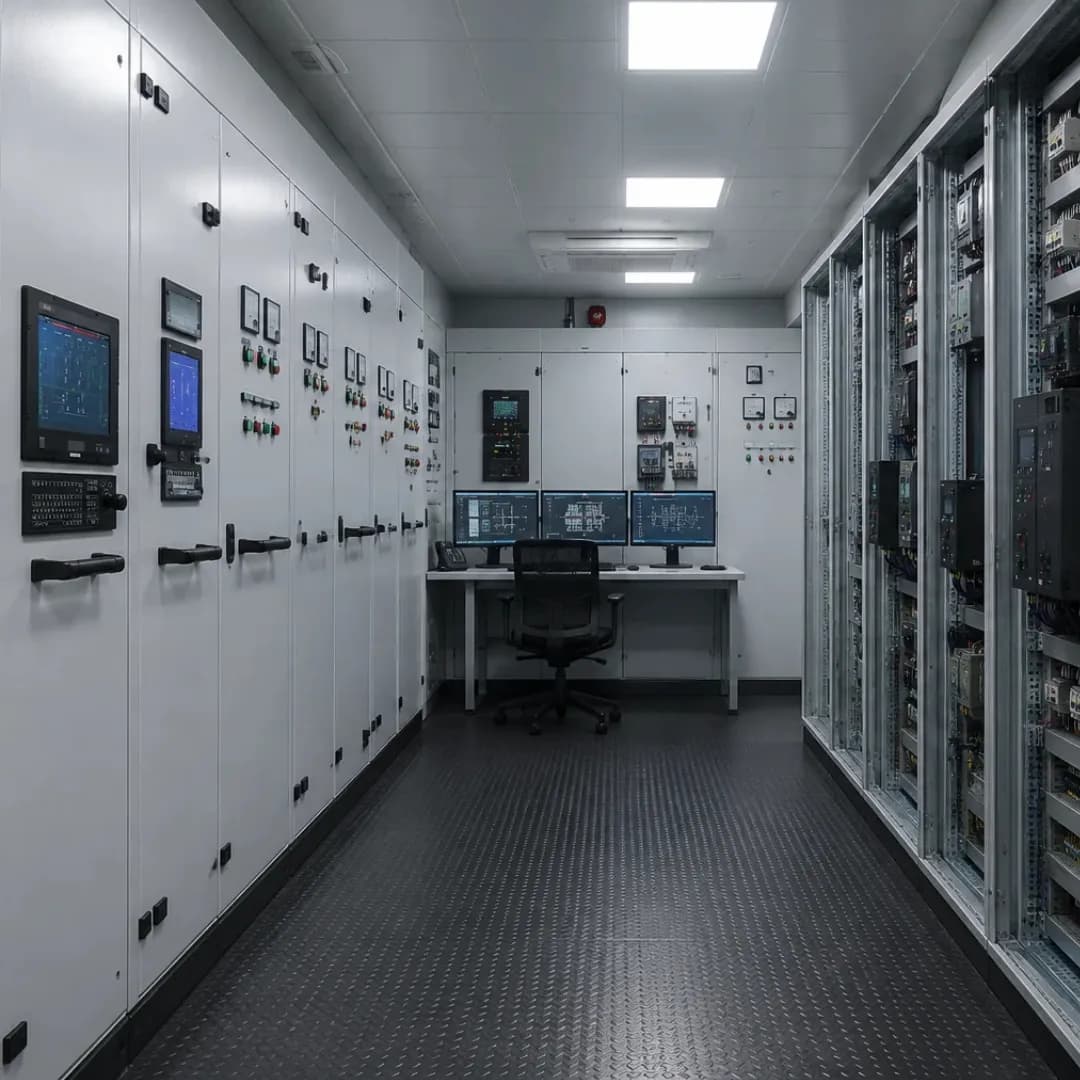
2000 HP Drilling Rig — Full Reactivation of the VFD System
Problem · SMEC scope · Architecture · Testing · Outcome
- Problem
- The rig faced critical downtime with inactive, aged drive systems: a dismantled generator control system with missing ACBs, bus bars, PTs, CTs and AVRs, damaged panels and wiring, crane-damaged enclosures, missing static converters and harmonic filters, and a water-damaged BOP control panel.
- SMEC scope
- SMEC restored and reactivated the VFD system with the VFD house, driller’s console, TDS house, MCC and BCU: replaced ACBs, AVRs, PTs and CTs, serviced reusable Woodward controllers, built new copper bus bars, rewired and reconditioned the panels, rebuilt the enclosures, installed ABB VFDs and filters, and supplied a new PLC-based BOP control system. Engineering and as-fitted drawings were delivered.
- Architecture
- Three VFDs for generator, draw works and rotary; PLC ladder logic and Woodward governor PID loops reconfigured and VFD parameters synced with generator load sharing; PLC monitoring of power factor and phase imbalance; BOP logic linked to remote monitoring over redundant fiber optics, with full diagnostics from the driller’s console.
- Testing
- Insulation resistance, continuity checks and load calculations on the rewired panels; interlocks simulated before live testing. The system passed FAT.
- Outcome
- System uptime from offline to 100% operational; remote command response under 1.5 sec; power load management stable with auto sync; fully energized within the drydock schedule.
Offshore Drilling Rigs — In-Situ Repair of AC and DC Modules, PCBs and ACBs
Problem · SMEC scope · Testing · Outcome
- Problem
- Under a rate contract, the operator needed a partner to diagnose and repair complex PCB systems across critical rig zones — driller’s console, engine room and control room — on non-standard legacy hardware degraded by salt-laden air, including failing surge suppression and power limit PCBs that affected generator safety.
- SMEC scope
- SMEC deployed a marine electronics team for in-situ and workshop repair of AC and DC modules, PCBs, heat sink–IGBT assemblies and air circuit breakers: reverse engineering of damaged PCBs on proprietary test jigs, hot-swap module servicing to keep rigs running, remote support to rig crews, and tracked logistics from the helibase to SMEC’s facility and back.
- Testing
- Functional simulation of generator exciter and auxiliary motor control PCBs before reinstallation; onboard functional testing with portable test benches and calibrated instruments; electro-thermal profiling of heat sinks; testing and calibration of 460V/600V AC ACBs. Every job documented with test logs and compliance records.
- Outcome
- PCB turnaround cut from 10–12 days to 72–96 hours; equipment downtime from 18+ hours to under 6 hours on average; ACB fault recurrence from 2x a month to 0 over 90 days+; field module failure below 1% after service, with 100% component functionality restored.
Engineering Approach — Repair, replace or modernise: an engineering decision
The most useful first step in an obsolescence project is a condition and supportability assessment. The team should identify failure history, available spares, software access, hardware compatibility, operating risk and the interfaces that would be affected by a replacement.
The resulting scope may be a targeted electronics repair, a refurbished drive, a PLC/HMI migration or a wider machinery-control retrofit. Testability, documentation and the ability to support the asset after handover should guide the choice—not replacement for its own sake.
Common questions
Can obsolete equipment be repaired instead of replaced?
Repair and refurbishment may be possible after condition, spares and risk assessment. Some systems require replacement or redesign.
Can old controls interface with modern SCADA?
Where data and protocol interfaces are available, gateways or controller upgrades may support integration.
What should be shared for a retrofit assessment?
Nameplates, OEM/model, photographs, drawings, software backups, fault history and available shutdown windows.
Have a Lifecycle & Obsolescence project to discuss?
Share the existing equipment, drawings, project location and scope of work.
Send the installed equipment list with make, model and firmware/software versions. Recommended RFQ inputs: project/asset, existing OEM/model, scope, drawings or specification, required date, site location, and any shutdown/mobilization constraint.
AE · Middle East & International
SMEC Oil & Gas Solutions LLC
Abu Dhabi, UAE
IN · India
SMEC Automation Pvt Ltd
Kochi, Kerala, India