
Lifecycle & Execution
Testing & Commissioning
Testing and commissioning prove that engineering, hardware, software and field interfaces work together before handover. SMEC supports FAT, integrated FAT, pre-commissioning, loop checks, SAT, functional testing, punch-list closure and handover documentation for defined project scope.
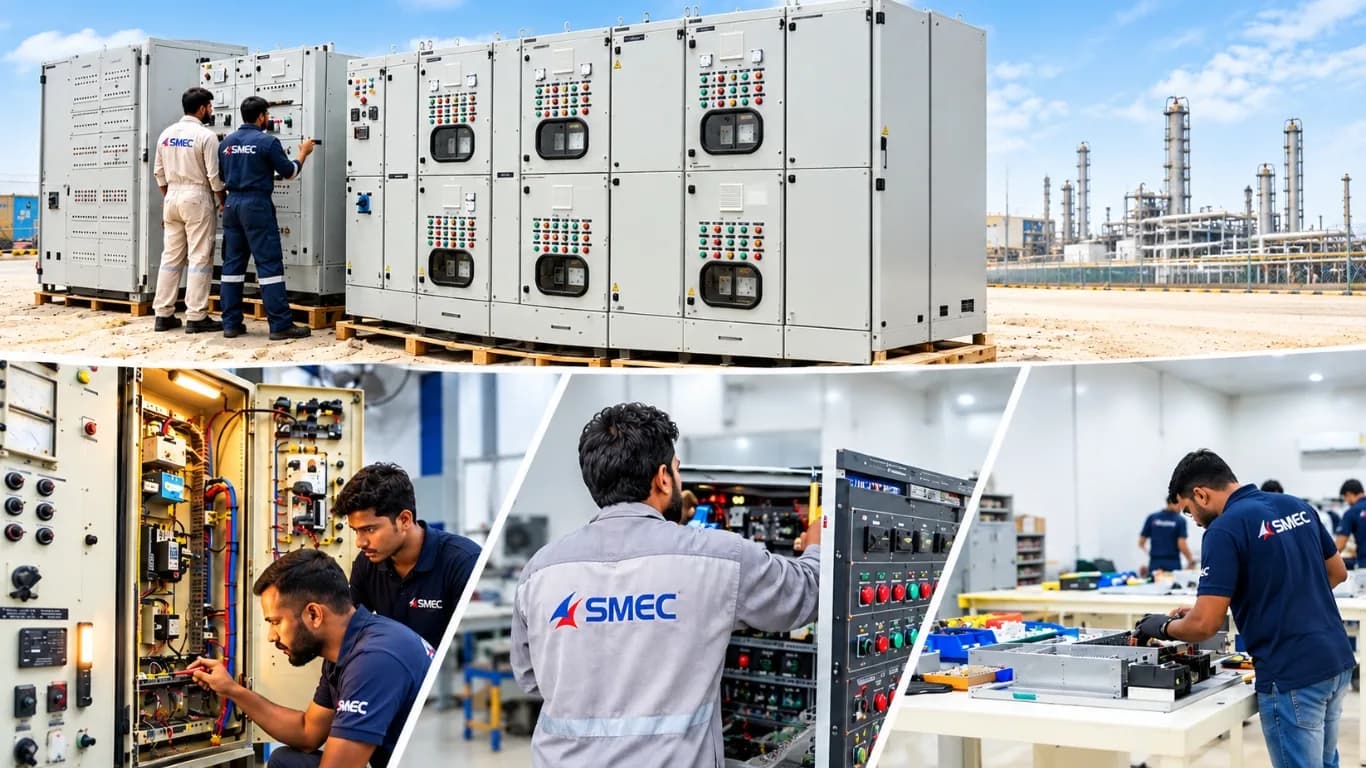
FAT, SAT & Commissioning
Verify the Equipment. Prove the Interfaces. Document the Result.
A panel can pass its own test while the integrated system still fails to exchange a critical alarm or command. Factory and site acceptance must test not only individual devices but the operating sequences, communication paths, interlocks and handover evidence connecting them.
SMEC supports electrical FAT, PLC/SCADA functional tests, instrument loops, safety-related interface verification, integrated SAT and commissioning documentation.
Explore engineering capabilities
Typical sequence
- Test procedure and acceptance criteria
- Panel inspection and I/O simulation
- Software/interlock testing
- Vendor/package interface testing
- Site loop checks and energization support
- SAT/functional tests
- Punch closure and as-built handover
Electrical FAT
Scope can include Wiring, Power and motor controls, Protection and related interfaces. Equipment selection, engineering responsibilities and testing are defined against the project specification.
- Wiring
- Power and motor controls
- Protection
- Test records
Control FAT
Scope can include PLC/HMI sequences, SCADA alarms, I/O simulation and related interfaces. Equipment selection, engineering responsibilities and testing are defined against the project specification.
- PLC/HMI sequences
- SCADA alarms
- I/O simulation
- Cause-and-effect
Instrumentation & Safety
Scope can include Loop checks, Gas detection, ESD/F&G interfaces and related interfaces. Equipment selection, engineering responsibilities and testing are defined against the project specification.
- Loop checks
- Gas detection
- ESD/F&G interfaces
- RTUs
Integrated SAT
Scope can include Package interfaces, PMS, Networks and related interfaces. Equipment selection, engineering responsibilities and testing are defined against the project specification.
- Package interfaces
- PMS
- Networks
- Punch lists
Commissioning & Records
Scope can include Startup, Troubleshooting, Traceability and related interfaces. Equipment selection, engineering responsibilities and testing are defined against the project specification.
- Startup
- Troubleshooting
- Traceability
- Handover
- Digital test records and traceability
Applications & Systems
Select a related system to open its dedicated product or system page.
Project Evidence
Integrated Factory Acceptance Test — Power and Automation Package
A packaged control system required coordinated verification before shipment. The proposed case study follows I/O simulation, interlock testing, alarm checks, communications, punch-list closure and handover documentation.

Jack-up Rig — Retrofit and Synchronization of Six Diesel Generators
Problem · SMEC scope · Architecture · Testing
- Problem
- An obsolete GE DG control system limited synchronization, load sharing and protection across the rig’s six 1050 kW diesel generators.
- SMEC scope
- SMEC retrofitted all six DGs with modern speed control, AVR and synchronization modules, tuned speed, voltage and droop for balanced load sharing, configured auto deloading and protection schemes, and handed over updated drawings, CT/PT settings and program backups.
- Architecture
- Woodward 2301A governors for speed control, EMRI LX20 AVRs for voltage regulation, and a DEIF PPU300 for automatic synchronization, load sharing and protection; 600 VAC at 1200 RPM across all six generators.
- Testing
- Each DG started and calibrated individually; manual synchronization by synchroscope, then automatic synchronization through the PPU300; protections verified. All six DGs ran stably and passed the rig endurance test and jacking operations under real load.

Oil & Gas Facilities — Retrofit Solutions and Advanced Control Systems
Problem · SMEC scope · Architecture · Testing · Outcome
- Problem
- Ageing equipment and harsh, hazardous environments: an outdated MCC that had to be retrofitted live, multi-gas detection in Zone 1 areas, a BOP control system on ageing infrastructure, and a remote well site needing reliable telemetry with minimal on-ground supervision.
- SMEC scope
- SMEC retrofitted an MCC with LSIG-configured ACBs, digital motor protection relays and Form 4B panels in a phased retrofit with no downtime; delivered a Gas Watch Panel with SIL-2 sensors and 2oo3 voting; developed primary and secondary injection test kits for protection systems; designed, installed and commissioned a PLC-based BOP control system with ring-topology networking; and built a custom RTU panel for the well site.
- Architecture
- RTU panel in a Zone 1-certified IP66 flameproof enclosure, with redundant 24VDC UPS-backed power, Modbus RTU/TCP and DNP3, fail-safe DI/DO with watchdog timers, data buffering and timestamped event logging, and secure VPN remote access.
- Testing
- RTU panel FAT-tested by SMEC; Gas Watch Panel components verified before deployment.
- Outcome
- RTU panel: seamless SCADA integration across 40+ km of pipeline infrastructure, and on-site intervention reduced by 65%.
Engineering Approach — Proving the integrated system, not only its components
A meaningful FAT starts with acceptance criteria linked to the functional specification. Individual equipment tests are followed by simulated commands, alarms, interlocks, permissives, loss-of-communication cases and interactions between power and control packages.
SAT then confirms the installation and actual field interfaces. Witness records, calibrated test equipment where required, punch-list tracking and signed handover documents make the results usable for operators, EPCs and asset owners. Remote witnessing or digital records should be included only where agreed for the project.
Common questions
What is the difference between FAT and SAT?
FAT verifies agreed functions before dispatch or site installation; SAT verifies installation and integrated functions in the site environment.
Can multiple OEM packages be tested together?
An integrated test plan can verify defined signals, commands, alarms, interlocks and communication failures across packages.
Are test records included?
The agreed scope should define checklists, witness requirements, punch lists, test evidence and final handover records.
Have a Testing & Commissioning project to discuss?
Share the existing equipment, drawings, project location and scope of work.
Send the system scope, test philosophy and required witness dates. Recommended RFQ inputs: project/asset, existing OEM/model, scope, drawings or specification, required date, site location, and any shutdown/mobilization constraint.
AE · Middle East & International
SMEC Oil & Gas Solutions LLC
Abu Dhabi, UAE
IN · India
SMEC Automation Pvt Ltd
Kochi, Kerala, India