
Project Engineering
E-Houses and Modular Electrical Rooms for Energy Projects
An E-House is a prefabricated, factory-integrated electrical room that brings project-specific power distribution, motor control, automation and auxiliary systems into a transportable module before site installation. SMEC positions E-Houses for oil & gas, LNG, petrochemical, pipeline, utility and industrial projects where off-site integration, FAT and reduced site interface work are commercially valuable.
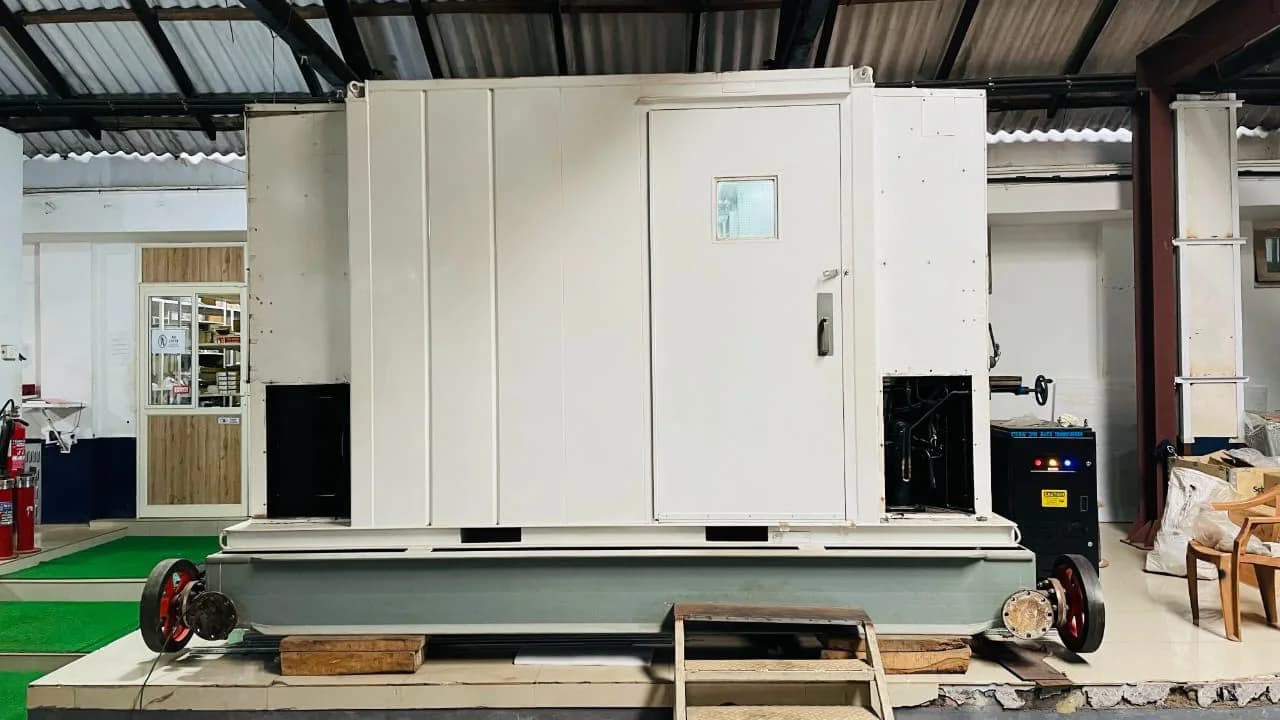
E-Houses & Modular Electrical Rooms
Electrical Infrastructure Engineered as One Complete Package.
A modular electrical room must bring distribution, drives, protection, critical power, ventilation and monitoring into a defined equipment envelope. Interface decisions made during engineering directly affect installation, access, testing and future maintenance.
SMEC supports integration scopes for E-Houses, SCR/VFD Houses and modular power packages involving MV/LV systems, MCC/PCC, UPS/DC, PLC/SCADA and auxiliary interfaces.
Explore engineering capabilities
Typical integrated scope
- MV/LV switchgear within approved project capability
- MCC, PCC, starter and distribution panels
- VFDs and soft starters
- UPS, battery chargers and DC distribution
- Protection, metering, PMS/ECMS interfaces
- PLC, HMI, SCADA and package-control interfaces
- Transformers/bus duct where included in approved scope
- HVAC and environmental control
- Fire alarm/fire & gas interfaces where specified
- Lighting, small power, earthing and internal cabling
- Network and remote-monitoring interfaces
- Structural enclosure, access, cable entry and transport engineering
MV/LV Distribution
Scope can include Transformers, Switchgear, Feeders and related interfaces. Equipment selection, engineering responsibilities and testing are defined against the project specification.
- Transformers
- Switchgear
- Feeders
- Protection
- Metering
- Earthing
Motor & Drives
Scope can include MCC/PCC, VFD, Soft starters and related interfaces. Equipment selection, engineering responsibilities and testing are defined against the project specification.
- MCC/PCC
- VFD
- Soft starters
- SCR drilling drives
- Motor protection
Critical Power & Auxiliaries
Scope can include UPS, Battery chargers, DC distribution and related interfaces. Equipment selection, engineering responsibilities and testing are defined against the project specification.
- UPS
- Battery chargers
- DC distribution
- HVAC
- Lighting
Automation & Safety
Scope can include PLC/SCADA, RTU, PMS and related interfaces. Equipment selection, engineering responsibilities and testing are defined against the project specification.
- PLC/SCADA
- RTU
- PMS
- Fire detection
- Electrical alarms
Modular Engineering & FAT
Scope can include Layout, Access, Cable routing and related interfaces. Equipment selection, engineering responsibilities and testing are defined against the project specification.
- Layout
- Access
- Cable routing
- Harmonic assessment
- Integrated FAT
Applications
- Remote oilfields
- Refineries
- Compressor stations
- EPC infrastructure
- Offshore modules
What the buyer is actually buying
Not an empty container. The value is coordinated integration: electrical equipment, controls, auxiliaries, communications, environmental requirements, transport constraints and FAT are engineered as one package before the module reaches site.
Digital-ready E-House
Where selected equipment supports it, protection, metering, breaker, drive, UPS, HVAC and auxiliary data can be exposed to ECMS/SCADA or an approved remote-monitoring architecture. IEC 61850 should be claimed only where the project architecture and selected equipment actually support it.
Project lifecycle
Requirements/load data → SLD and architecture → equipment/enclosure engineering → interface matrix → detailed design → fabrication/integration → software/configuration → FAT → transport → site hook-up → SAT/commissioning → lifecycle support.
E-House vs Rig Power House
E-House = broad modular electrical room for plant/project distribution, motor control, automation and auxiliaries. Rig Power House = drilling-specific transportable power/control architecture around PCR/SCR/VFD and rig power requirements.
Applications & Systems
Select a related system to open its dedicated product or system page.
Project Evidence
Modular Electrical Power House — Integrated Distribution and Drives
A drilling or industrial package required power conversion and distribution within a modular enclosure. The project summary covers drive panels, MCC interfaces, ventilation, protection, cabling and integrated factory tests.

Offshore Rig — 1350 HP Top Drive VFD System Panel
Problem · SMEC scope · Architecture · Testing
- Problem
- An offshore operator needed a high-capacity 1350 HP top drive VFD system panel that would deliver precise control and survive extreme drilling conditions from -20°C to +50°C, plugging into the existing rig power and control systems with no margin for retrofit errors offshore.
- SMEC scope
- SMEC supplied and installed the complete top drive VFD system in a 20-ft container: drive section, auxiliary section, distribution panel with step-down transformer, PLC section and plug panels for all incoming and outgoing feeders.
- Architecture
- Oil-cooled heavy-duty VFD on a 600 VAC, 1800 A, 3-phase supply, with custom drive tuning, harmonic filters and surge protection; segregated drive, PLC and auxiliary zones; dual redundant 5-ton AC units under PLC cooling control; multi-point fire detection linked to ESD logic, and PLC alarms for temperature, humidity and doors.
- Testing
- Full logic tested before deployment, and FAT simulated with the client before shipment.
Engineering Approach — Engineering the complete modular electrical package
An E-House is defined by the interactions between its equipment and enclosure. Load calculations, switchgear and drive selection, cable routing, ventilation, maintainability, fire detection, earthing and transport limitations need to be considered together.
Modular execution can bring more interface testing into the workshop, but only if the factory test plan includes realistic control, protection, communications and auxiliary scenarios. Site work still requires careful installation verification and integration with the upstream and downstream plant.
E-Houses That Arrive as Integrated Electrical Infrastructure
An E-House should reduce site installation work—not transfer integration problems to site. SMEC approaches modular electrical rooms as complete interfaces between power distribution, automation, HVAC, fire safety, civil foundations and cable routing.
How it works
Modular infrastructure — The E-House integrates switchgear, transformers, MCCs, automation and auxiliaries within a prefabricated structure engineered for transportation and installation.
Structure and logistics — Lifting points, floor loading, transport envelope, cable entry, wind/seismic design and foundation interfaces are developed with the electrical layout.
Environmental protection — Heat-load calculations, air filtration, cooling redundancy, corrosion exposure and ingress protection shape the building envelope.
Factory integration — A complete integrated FAT can check electrical, controls, alarms and auxiliaries before shipment, reducing on-site interface risk.
Key components
Modular enclosure and structural interfaces. The modular enclosure and structural interfaces is selected for the equipment, operating duty and site conditions.
MV/LV switchgear. The mv/lv switchgear is selected for the equipment, operating duty and site conditions.
Transformers. Transformer impedance, winding arrangement, cooling, insulation class and protection must suit the upstream fault level and downstream conversion equipment.
MCC/PCC. The mcc/pcc is selected for the equipment, operating duty and site conditions.
UPS/DC. UPS/DC autonomy is selected from critical load demand and required ride-through duration; battery maintenance and alarm contacts must be considered.
HVAC. The hvac is selected for the equipment, operating duty and site conditions.
Fire alarm. Alarm thresholds, priorities, delays and operator actions must be documented to avoid nuisance alarms and missed critical events.
Lighting. The lighting is selected for the equipment, operating duty and site conditions.
Cable management. The cable management is selected for the equipment, operating duty and site conditions.
Remote monitoring. The remote monitoring is selected for the equipment, operating duty and site conditions.
Upgrades & retrofits
Add monitoring, UPS or automation cabinets where space and cooling margins permit.
Replace ageing switchgear/drive equipment within the existing module.
Use a replacement module to minimise live-site construction and installation time.
Retrofit scope depends on existing OEM interfaces, component condition, available space, shutdown windows and the approval basis of any safety-related functions.
Testing & documentation
Relevant IEC, ISO, API, classification-society, hazardous-area or functional-safety requirements must be selected according to the specific system and installation. Where applicable, the project package may include electrical drawings, GA layouts, datasheets, I/O schedules, cause-and-effect, communication lists, inspection records, FAT/SAT procedures, calibration records and as-built documents. No unverified compliance certification is claimed here.
Common questions
What can be integrated inside an E-House?
Project-defined switchgear, MCC/PCC, drives, UPS/DC, control and automation, HVAC and auxiliaries can be integrated subject to the approved design and project requirements.
Is the E-House design project-specific?
Yes. Electrical ratings, fault level, environmental requirements, structural limits, fire/blast requirements and certification scope must be confirmed for the project.
What is needed for quotation?
Send the SLD, load list, equipment schedule, layout or dimensional constraints, environmental data, standards, site, transport limits and required delivery date.
What equipment can be integrated inside an E-House?
Depending on the design: switchgear, transformers, MCC/VFD, UPS/DC, protection, PLC/SCADA, HVAC and fire-alarm interfaces.
Can testing be completed before shipment?
Defined electrical, control and communication functions can be included in an integrated FAT plan, subject to available equipment and interfaces.
What is needed for a modular package RFQ?
SLD, load list, site environmental conditions, equipment schedule, footprint and transport constraints.
Is an E-House the same as a container?
No. An E-House is an engineered electrical facility with defined structural, electrical and environmental requirements.
Can an E-House contain both switchgear and automation?
Yes, provided separation, access, heat load and applicable safety requirements are addressed.
What is needed to size an E-House?
Equipment list, SLD, site conditions, transport restrictions and service-access requirements.
Have an E-Houses & Modular Electrical Rooms project to discuss?
Share the existing equipment, drawings, project location and scope of work.
Send the E-House SLD, load list, voltage levels, fault level, protection philosophy, environmental data, hazardous-area requirements, transport envelope and delivery date. Recommended RFQ inputs: project/asset, existing OEM/model, scope, drawings or specification, required date, site location, and any shutdown/mobilization constraint.
AE · Middle East & International
SMEC Oil & Gas Solutions LLC
Abu Dhabi, UAE
IN · India
SMEC Automation Pvt Ltd
Kochi, Kerala, India