Electrical & Automation
PLC, SCADA & DCS Migration
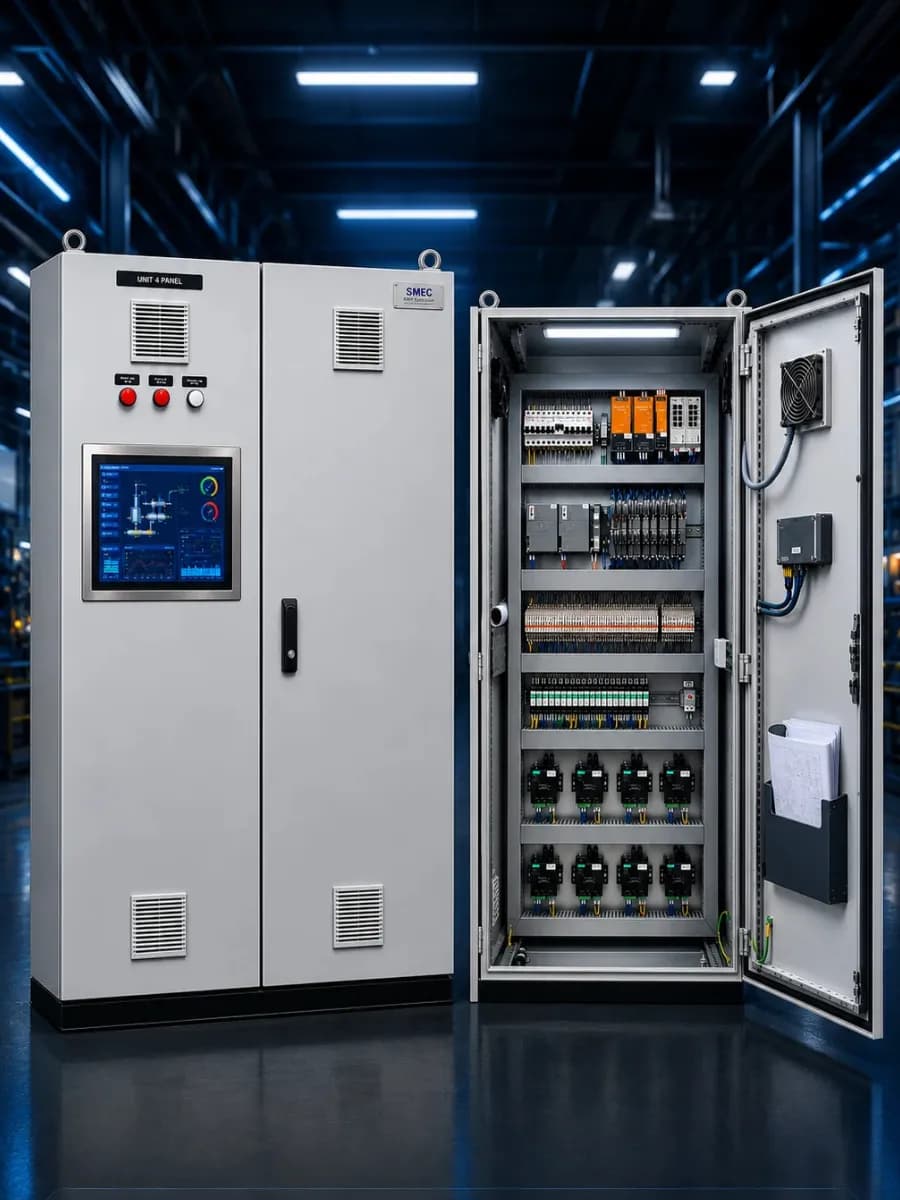
Control-system migration replaces unsupported hardware or software while preserving the process logic, field interfaces and operating intent that still matter. SMEC treats migration as an engineering and cutover project, not a simple controller swap.
PLC, SCADA & DCS Migration
Modernise the Controls. Keep the Process Knowledge.
A legacy PLC may still run a process reliably while its software, spare parts and communication interfaces become increasingly difficult to support. Modernisation must protect operating logic, field wiring, drive interfaces, alarms and safety dependencies—not simply replace a processor.
SMEC evaluates installed controller platforms, software backups, I/O architecture, SCADA/HMI dependencies and cutover constraints to define practical migration and retrofit scopes.
Explore engineering capabilities
Migration scope
- Installed-base audit
- I/O and field-wiring assessment
- Logic/document recovery
- New architecture and network design
- Code conversion/re-engineering
- HMI/SCADA redevelopment
- Simulation/FAT
- Staged cutover and rollback plan
- SAT and operator handover
Schneider Electric
Scope can include Modicon Quantum and Premium, M340 and M580, Control Expert and related interfaces. Equipment selection, engineering responsibilities and testing are defined against the project specification.
- Modicon Quantum and Premium
- M340 and M580
- Control Expert
- I/O and communication migration
Siemens
Scope can include SIMATIC S5, S7-300/400, S7-1200/1500 and related interfaces. Equipment selection, engineering responsibilities and testing are defined against the project specification.
- SIMATIC S5
- S7-300/400
- S7-1200/1500
- WinCC
- PROFIBUS and PROFINET
Allen-Bradley & ABB
Scope can include PLC-5, SLC 500, ControlLogix and CompactLogix and related interfaces. Equipment selection, engineering responsibilities and testing are defined against the project specification.
- PLC-5
- SLC 500
- ControlLogix and CompactLogix
- FactoryTalk
- ABB AC500 and 800xA interfaces
DCS & SCADA Platforms
Scope can include AVEVA/Wonderware, DeltaV interfaces, Honeywell Experion interfaces and related interfaces. Equipment selection, engineering responsibilities and testing are defined against the project specification.
- AVEVA/Wonderware
- DeltaV interfaces
- Honeywell Experion interfaces
- Siemens PCS 7
- Gateways
Migration & Cutover
Scope can include Backups and firmware review, Logic and I/O mapping, ESD/F&G dependencies and related interfaces. Equipment selection, engineering responsibilities and testing are defined against the project specification.
- Backups and firmware review
- Logic and I/O mapping
- ESD/F&G dependencies
- VFD and protection interfaces
- OT network segmentation
- FAT and SAT
- OT network and backup readiness assessment
- Critical-spares and software dependency review
Applications & Systems
Select a related system to open its dedicated product or system page.
Project Evidence
Legacy PLC and SCADA Migration — Process Control Modernisation
An ageing process-control installation needed replacement without losing critical operating logic. The project story follows I/O mapping, program conversion, HMI redevelopment, staged cutover and commissioning checks.

Offshore Drilling Rig — SCR System Inspection and Upgrade
Problem · SMEC scope · Architecture
- Problem
- An ageing SCR system had obsolete modules no longer supported by the OEM, overheating cables, voltage drops, failing relay panels, a mix of control voltages and no local control for the mud pumps. SMEC’s visual, thermal and component inspection, with the onboard technical staff, set out the risks.
- SMEC scope
- SMEC replaced obsolete logic and contactors with a PLC-based control system, fitted new cables and voltage regulation circuits and improved airflow in the SCR compartments, installed a new relay and metering panel, standardised all control circuits to one voltage, and added a dedicated mud pump local panel.
- Architecture
- Seven SCR units: SCR-1 to SCR-4 for draw works and mud pump selection, SCR-5 for mud pump 3 via PLC and VFDs, and SCR-6 and SCR-7 for the top drive.

Jack-up Rig — Retrofit and Synchronization of Six Diesel Generators
Problem · SMEC scope · Architecture · Testing
- Problem
- An obsolete GE DG control system limited synchronization, load sharing and protection across the rig’s six 1050 kW diesel generators.
- SMEC scope
- SMEC retrofitted all six DGs with modern speed control, AVR and synchronization modules, tuned speed, voltage and droop for balanced load sharing, configured auto deloading and protection schemes, and handed over updated drawings, CT/PT settings and program backups.
- Architecture
- Woodward 2301A governors for speed control, EMRI LX20 AVRs for voltage regulation, and a DEIF PPU300 for automatic synchronization, load sharing and protection; 600 VAC at 1200 RPM across all six generators.
- Testing
- Each DG started and calibrated individually; manual synchronization by synchroscope, then automatic synchronization through the PPU300; protections verified. All six DGs ran stably and passed the rig endurance test and jacking operations under real load.
Jack-up Rig — PLC Upgrade for Jacking System Control
Problem · SMEC scope · Architecture
- Problem
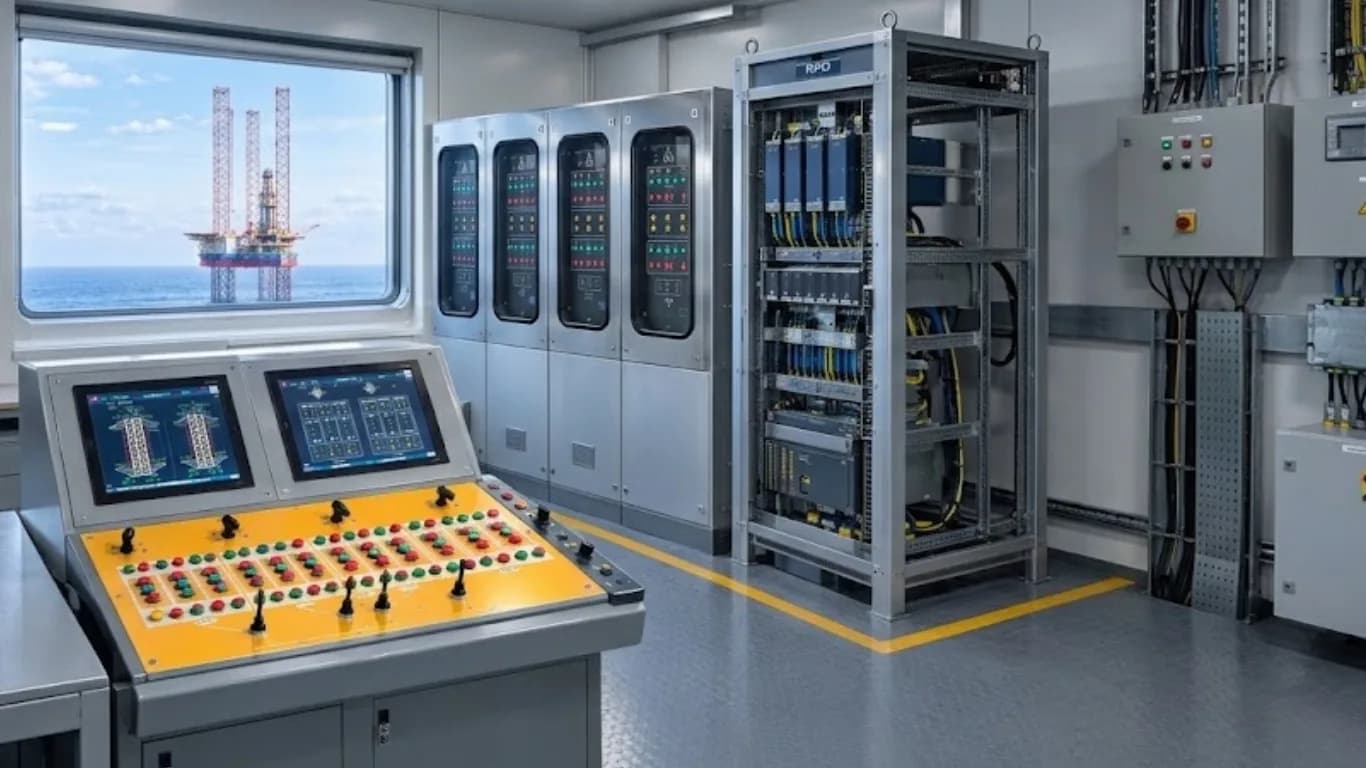
- An offshore drilling contractor needed a simple, reliable PLC control system for the hydraulic functions of its four-legged electrohydraulic jack-up system, to improve the efficiency, safety and precision of jacking operations.
- SMEC scope
- SMEC developed the PLC-based jacking control system, integrated the motor control station with an alarm panel and SCR interfacing, installed analogue stroke movement monitors on the hydraulic cylinders and an inclination monitoring and alarm system, and upgraded communication to optic fiber.
- Architecture
- PLC jacking control, motor control station with alarm panel and SCR interface, four analogue stroke movement monitors, inclination monitoring and alarms, and an optic fiber communication link.
Engineering Approach — Modernising controls without losing process knowledge
Legacy migration starts by recovering what the plant already knows: installed hardware, controller logic, I/O assignments, operator displays, network dependencies, instrument signals and available software backups. Where documentation is incomplete, site verification and reverse engineering may be needed before selecting replacement equipment.
The cutover strategy is then designed around operating risk. Logic comparison, I/O mapping, alarm validation, interface simulation, staged FAT and rollback planning can reduce uncertainty. The objective is to modernise the control platform while preserving agreed process behaviour and making future support more practical.
Common questions
Can the existing field wiring and I/O be retained?
That depends on survey findings, I/O condition, compatibility, safety requirements and the cutover strategy. Retention should be an engineering decision, not an assumption.
Can modernization be phased around operations?
Where the architecture permits, migration can be planned in stages around shutdown, turnaround or campaign constraints. The final method depends on interfaces and operational risk.
What should be provided for assessment?
Share the existing control architecture, hardware/software versions, I/O count, drawings, backups where available, known faults, obsolescence concerns and the available shutdown window.
Can a PLC be migrated without replacing all field wiring?
Potentially. It depends on I/O compatibility, wiring condition, safety dependencies and the cutover strategy established after an installed-base review.
Which legacy platforms can be assessed?
The scope can consider legacy Schneider, Siemens, Allen-Bradley, ABB and other installed platforms; exact support is subject to technical evaluation.
How is downtime addressed?
By reviewing backups, interfaces, FAT simulation, staged installation, rollback planning and the available shutdown window.
Have a Control System Migration project to discuss?
Share the existing equipment, drawings, project location and scope of work.
Send the platform/version, I/O count, drawings, backups and required outage window. Recommended RFQ inputs: project/asset, existing OEM/model, scope, drawings or specification, required date, site location, and any shutdown/mobilization constraint.
AE · Middle East & International
SMEC Oil & Gas Solutions LLC
Abu Dhabi, UAE
IN · India
SMEC Automation Pvt Ltd
Kochi, Kerala, India