
Products
MCC, PCC & Power Distribution Panels
MCCs and PCCs organize motor feeders, protection, switching, metering and automation interfaces into maintainable electrical assemblies. SMEC can support new panels, replacements and brownfield modifications against approved project specifications.
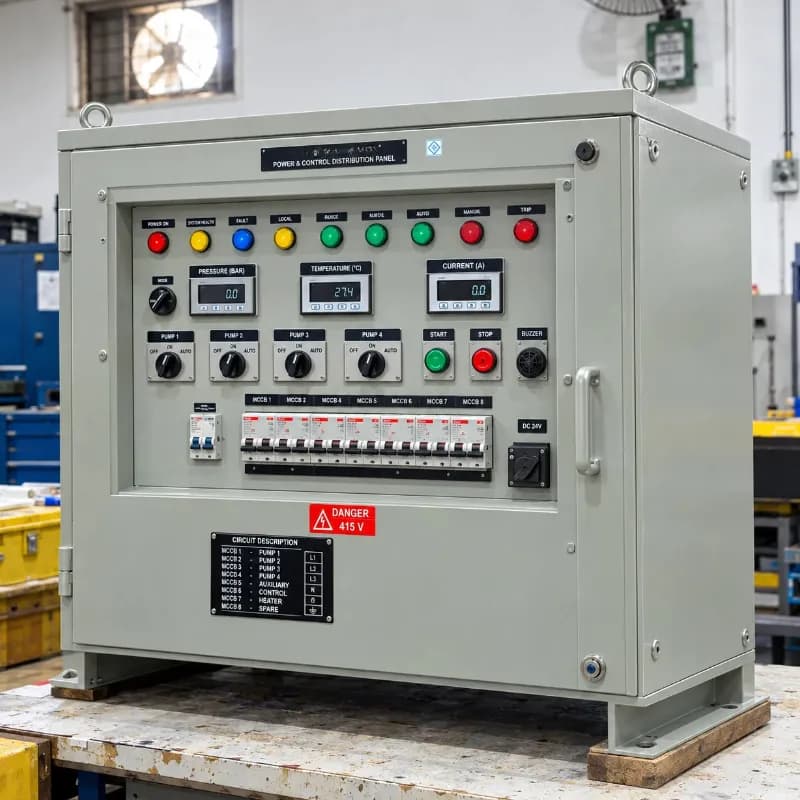
Control Panels Designed for the Plant They Will Actually Operate
A control panel is the physical point where power, signals, protection and maintenance meet. SMEC engineers industrial panels to suit the equipment duty, installation environment, interface requirements and factory acceptance criteria—not simply a standard enclosure size.
2026 market / lifecycle context
Brownfield demand is driven as much by obsolescence, spare availability and expansion as by new CAPEX. Retrofit-friendly panel engineering is therefore as important as new-build manufacture.
System architecture / typical scope
- MCC/PCC feeders
- DOL/star-delta/soft starter/VFD feeders as defined
- Protection and metering
- PLC/SCADA contacts/communications
- Bus/feeder interfaces
- Panel auxiliaries
What SMEC can support
- Requirements and interface review
- Detailed engineering and approved component selection
- Panel/package build or integration within SMEC capability
- Software/configuration where applicable
- FAT and documentation
- Site integration, SAT and commissioning
- Retrofit, troubleshooting and lifecycle support
Applications
- Refineries
- Factories
- Marine
- Rigs
- Utilities
- EPC projects
How it works
Power panels — MCCs manage motor feeders; PCCs distribute electrical power; starter panels provide defined motor starting/protection arrangements.
Automation panels — PLC, HMI, RTU, marshalling and VFD panels combine control hardware with plant field and network interfaces.
Electrical design — Continuous current, short-circuit withstand, heat dissipation, segregation, wiring and earthing are engineered for the application.
Factory verification — Panel inspection, wiring continuity, I/O simulation, protection settings and functional FAT are specified for the delivered scope.
Key components
MCC and PCC. The mcc and pcc is selected for the equipment, operating duty and site conditions.
PLC/HMI/SCADA panels. PLC/HMI functions present status, operating modes, permissives, faults and event history. Commands and safety-related shutdown functions must remain correctly separated.
VFD and soft-starter panels. Panel layout, ingress protection, segregation, component selection and service clearance follow the installation environment, load schedule and maintenance requirements.
Starter panels. Panel layout, ingress protection, segregation, component selection and service clearance follow the installation environment, load schedule and maintenance requirements.
RTU and marshalling panels. An RTU acquires remote station measurements and status, timestamps events and exchanges authorised commands with SCADA while preserving local control on link loss.
Distribution boards. The distribution boards is selected for the equipment, operating duty and site conditions.
ESD/F&G interfaces. The esd/f&g interfaces is selected for the equipment, operating duty and site conditions.
Custom control desks. The custom control desks is selected for the equipment, operating duty and site conditions.
Upgrades & retrofits
Replace obsolete PLCs, breakers, drives and starters in existing panel footprints when feasible.
Expand feeder or I/O capacity subject to electrical/thermal checks.
Add remote diagnostics and improve documentation/FAT coverage.
Retrofit scope depends on existing OEM interfaces, component condition, available space, shutdown windows and the approval basis of any safety-related functions.
Testing & documentation
Relevant IEC, ISO, API, classification-society, hazardous-area or functional-safety requirements must be selected according to the specific system and installation. Where applicable, the project package may include electrical drawings, GA layouts, datasheets, I/O schedules, cause-and-effect, communication lists, inspection records, FAT/SAT procedures, calibration records and as-built documents. No unverified compliance certification is claimed here.
Control-panel landing page
SMEC's own page for control-panel enquiries.
Project evidence
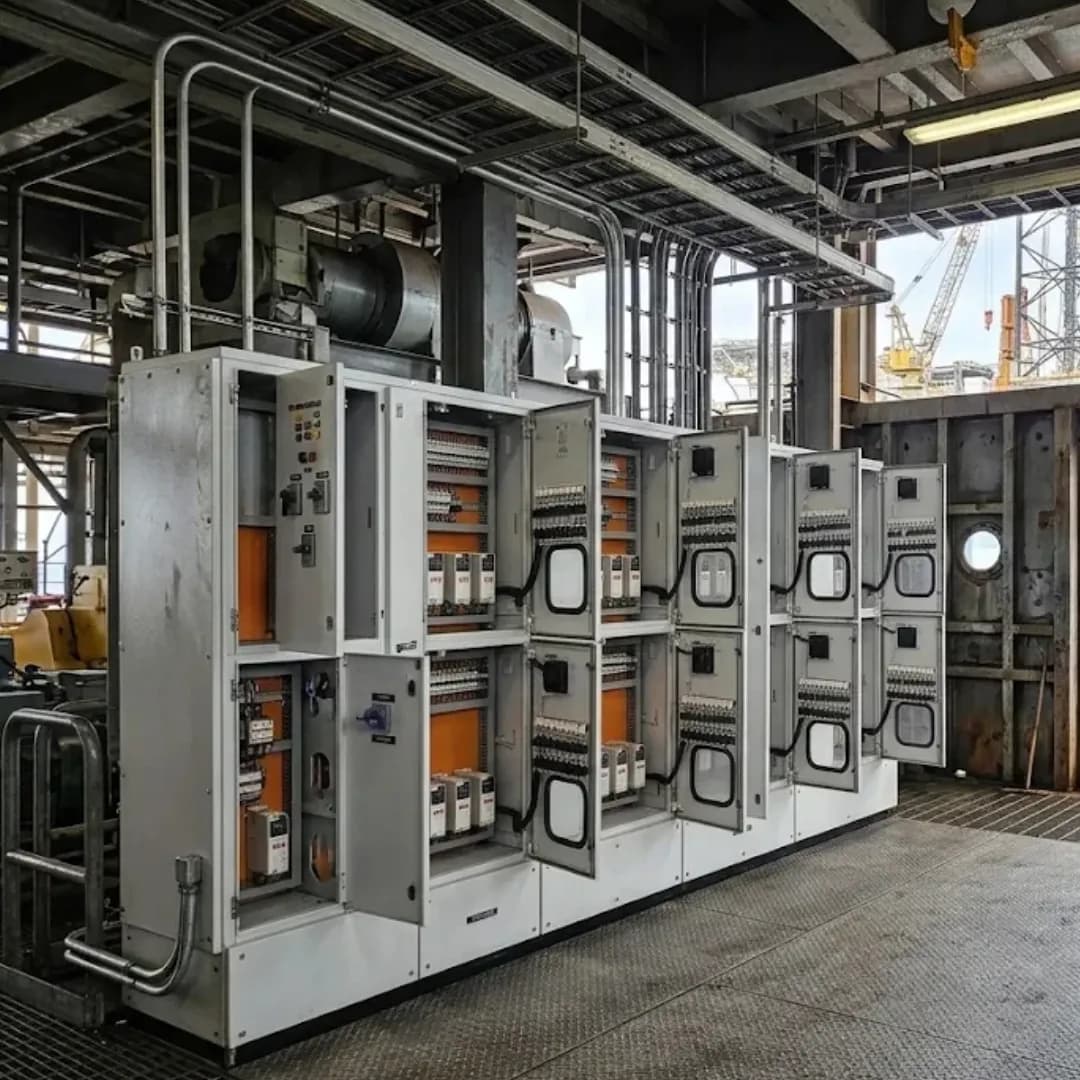
Offshore Rig — Emergency MCC, Transformer and DG Switchboard Upgrade
Problem · SMEC scope · Architecture · Testing
- Problem
- The rig’s emergency power system needed upgrading to improve reliability, efficiency and safety in emergencies, minimise downtime and make maintenance easier.
- SMEC scope
- SMEC designed, manufactured, supplied, installed and commissioned a DG switchboard panel in the MSB room, a DG power isolation panel near the generator, a new transformer and a new Emergency Motor Control Centre, and supplied, installed and commissioned a new emergency generator excitation unit.
- Architecture
- Main switchboard extended with 100x8mm copper bus bars, 4-run per phase, and an additional generator section; 1250 kVA, 600/480 V delta-star dry-type transformer with Class H insulation; modular EMCC with compact bus bars in a prefabricated enclosure for a constrained space; arc-fault detection relays on the isolation panel; Basler excitation unit for the 1625 kVA, 1300 kW emergency alternator.
- Testing
- Load flow analysis for the switchboard extension; harmonic analysis and insulation testing on the transformer; real-time voltage regulation testing and excitation tuning on the generator. Every item installed and commissioned, and confirmed working by rig staff.

Oil & Gas Facilities — Retrofit Solutions and Advanced Control Systems
Problem · SMEC scope · Architecture · Testing · Outcome
- Problem
- Ageing equipment and harsh, hazardous environments: an outdated MCC that had to be retrofitted live, multi-gas detection in Zone 1 areas, a BOP control system on ageing infrastructure, and a remote well site needing reliable telemetry with minimal on-ground supervision.
- SMEC scope
- SMEC retrofitted an MCC with LSIG-configured ACBs, digital motor protection relays and Form 4B panels in a phased retrofit with no downtime; delivered a Gas Watch Panel with SIL-2 sensors and 2oo3 voting; developed primary and secondary injection test kits for protection systems; designed, installed and commissioned a PLC-based BOP control system with ring-topology networking; and built a custom RTU panel for the well site.
- Architecture
- RTU panel in a Zone 1-certified IP66 flameproof enclosure, with redundant 24VDC UPS-backed power, Modbus RTU/TCP and DNP3, fail-safe DI/DO with watchdog timers, data buffering and timestamped event logging, and secure VPN remote access.
- Testing
- RTU panel FAT-tested by SMEC; Gas Watch Panel components verified before deployment.
- Outcome
- RTU panel: seamless SCADA integration across 40+ km of pipeline infrastructure, and on-site intervention reduced by 65%.
Common questions
Can MCC, PCC & Power Distribution Panels be supplied for new build, retrofit or replacement?
The lifecycle route depends on the installed base, condition, interfaces, obsolescence and project requirements. SMEC can assess new-build, retrofit, repair or replacement scope where technically valid.
Can existing field wiring or interfaces be retained?
Possibly. Retention depends on survey findings, condition, ratings, compatibility, safety requirements, documentation and the cutover strategy.
What information is required for quotation?
Send the make/model or required specification, datasheets, drawings, ratings, interfaces, fault details where applicable, site location and required date or shutdown/mobilization window.
What is the difference between MCC and PCC?
An MCC focuses on motor feeders/control; a PCC handles broader power distribution and control.
Can a panel be built to an existing plant standard?
Yes, after reviewing approved specifications, makes, ratings and documentation requirements.
What should be shared for pricing?
SLD, I/O list, load list, drawings, standards, quantities and site conditions.
Have a MCC, PCC & Power Distribution Panels project to discuss?
Share the existing equipment, drawings, project location and scope of work.
SLD, load/motor list, fault level, feeder schedule, protection philosophy, communications and enclosure requirements.
AE · Middle East & International
SMEC Oil & Gas Solutions LLC
Abu Dhabi, UAE
IN · India
SMEC Automation Pvt Ltd
Kochi, Kerala, India