GAIL was incorporated on 16 August 1984, but beginning its story with that date misses the reason the company had to exist.
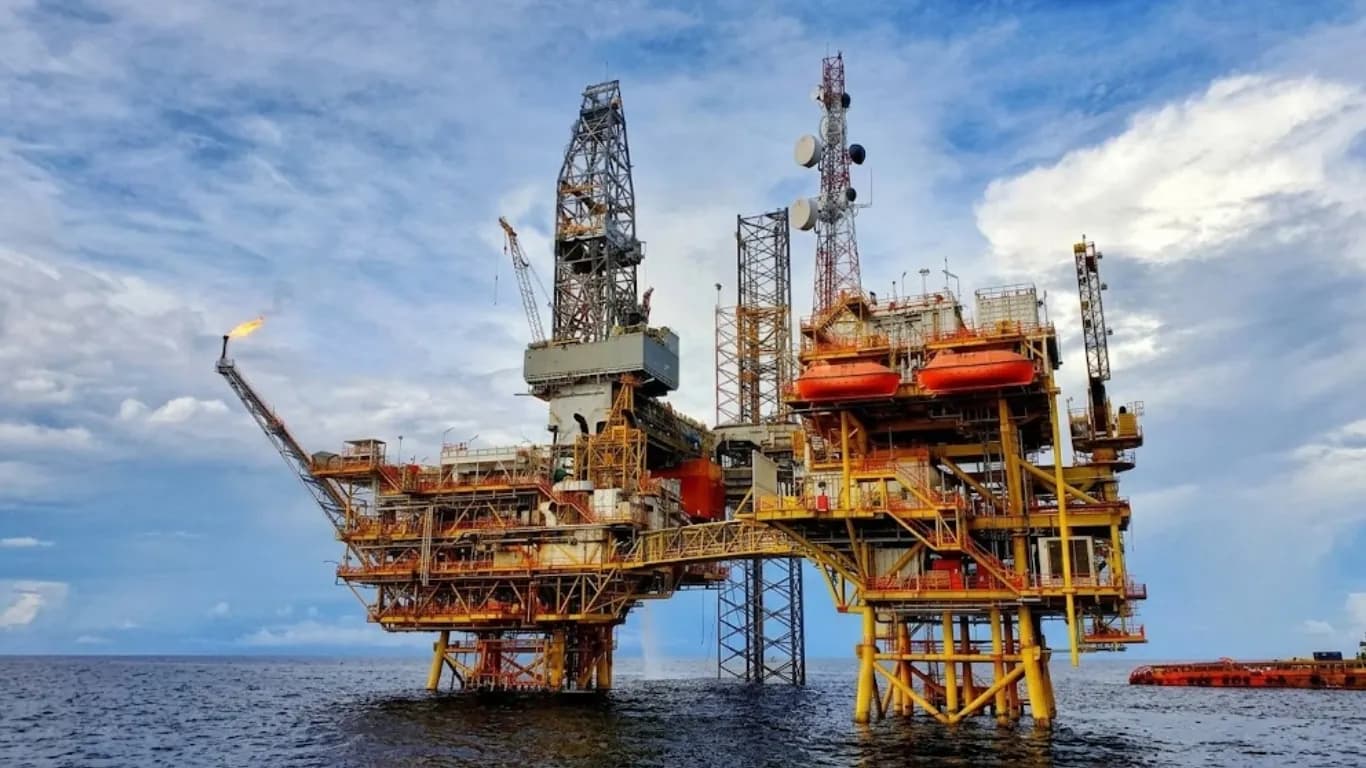
The more revealing starting point lies offshore, in an India that was discovering increasingly important hydrocarbon resources but had not yet developed a national natural-gas economy.
By the 1970s, ONGC's western offshore discoveries had begun altering India's energy landscape. Bombay High became the celebrated oil story, but for the history of GAIL, the development of natural-gas resources around South Bassein is particularly important.
India had discovered something valuable. The difficulty was using it.
Natural gas does not become economically useful merely because it exists underground. Unlike crude oil, which can be stored and moved by several modes before reaching a refinery, large-scale gas utilisation requires an almost continuous chain between source and consumer. Production has to connect with processing; processing with transmission; transmission with large and dependable demand; and all of it must make commercial sense simultaneously.
That architecture barely existed in India.
The country had ONGC and Oil India producing hydrocarbons. Indian Oil was developing refining and downstream infrastructure. Fertilizer plants, power stations and industries were expanding. Yet the large potential consumers of natural gas were scattered hundreds of kilometres from the western offshore fields.
The problem facing India was therefore larger than building a pipeline.
How do you create a market for a molecule when the infrastructure needed by the market does not yet exist - and the infrastructure itself needs a market before it can be economically justified?
That question sits at the beginning of the GAIL story.
One of the more interesting facts in GAIL's history is that the project most closely associated with its birth was conceived before the company itself.
ONGC had begun conceptualising what became the Hazira–Vijaipur–Jagdishpur Pipeline — HVJ, historically also called HBJ. The objective was ambitious for its time: take gas associated with India's western offshore resources and create a cross-country route capable of supplying fertilizer plants, power stations and industries across western, central and northern India.
The scale of the undertaking made something else increasingly apparent. India required an organisation focused specifically on gas , not merely its production, but its transportation, marketing and economic utilisation.
That institutional requirement led to the creation of Gas Authority of India Limited in 1984.
This distinction matters because it changes how GAIL's subsequent diversification should be interpreted. The company was not born simply as the owner of a pipeline. Its underlying purpose was connected to a much larger national problem: how to turn natural gas into a commercially usable energy resource across a geographically enormous country.
HVJ was not merely infrastructure. It began reorganising where gas could be consumed.
The original HVJ system extended roughly 1,700–1,800 kilometres, with an initial capacity of around 18.2 MMSCMD and an investment of approximately ₹1,700 crore.
Those numbers were substantial for 1980s India, but they do not explain the project's historical importance.
What mattered was what became possible after the pipe existed.
Western offshore gas could now travel inland to fertilizer, power and industrial consumers that previously had no practical access to it. Large fertilizer plants became particularly important anchor customers because they could absorb volumes substantial enough to support pipeline economics.
A fascinating economic relationship developed.
The pipeline needed customers to justify its existence, but many of those customers needed the pipeline before gas could become a realistic feedstock or fuel.
This is one of the recurring patterns in GAIL's history: infrastructure did not always follow demand; infrastructure frequently created the conditions in which demand could emerge.
HVJ therefore did more than transport gas. It began connecting previously separate pieces of an energy economy - production, transmission and consumption.
And once that system existed, GAIL's next question became unavoidable.
Was transporting the molecule enough?
Once gas began moving through the new network, the next economic question was obvious.
If GAIL handled the molecule, should it capture value only from transporting it?
The answer increasingly became no.
GAIL commissioned its first LPG plant at Vijaipur in 1991. In 1992, regional gas-pipeline systems previously operated by ONGC were transferred to GAIL.
Gas processing expanded.
Valuable liquid hydrocarbons could be recovered from the gas stream rather than simply transporting the gas downstream.
That business remains significant today.
GAIL currently operates five gas-processing units across four principal locations - Vijaipur, Pata, Gandhar and Vaghodia - with around 1.4 million tonnes per annum of LPG and other liquid-hydrocarbon production capacity.
What had begun as a transmission company was therefore becoming a processor of the molecule as well.
GAIL’s next major expansion moved the gas economy closer to ordinary consumers.
Early gas demand had been dominated by large industrial users. Fertilizer plants could consume enormous quantities of gas; individual households obviously could not.
City Gas Distribution solved that scale problem by aggregating thousands and eventually millions of smaller consumers.
GAIL became involved in the development of Mahanagar Gas in Mumbai and Indraprastha Gas in Delhi, followed by a much wider portfolio of CGD companies.
The significance was considerable.
Natural gas was no longer confined to fertilizer plants, power stations or industrial facilities.
It entered households as PNG.
It entered urban mobility as CNG.
It reached restaurants, commercial establishments and smaller industries.
Today GAIL’s group companies operate across 72 authorised geographical areas in 21 states and Union Territories, serving approximately 10.9 million PNG customers, more than 3,430 CNG stations, over 9,230 industrial consumers and more than 21,700 commercial units.
That is one of the least appreciated transformations in the history of the Indian gas market.
The customer base itself changed.
The commissioning of the Pata Petrochemical Complex in Uttar Pradesh in 1999 represented another strategic change.
A transmission business earns primarily from moving a commodity.
A petrochemical business earns by transforming that commodity into a higher-value product.
At Pata, gas-derived feedstocks entered polymer production.
The value chain had lengthened:
Natural gas → transmission → processing → feedstock → petrochemicals → polymers.
Pata now has approximately 810 KTA of polymer capacity.
The petrochemical portfolio has since expanded far beyond Pata.
GAIL’s subsidiary Brahmaputra Cracker and Polymer Limited operates approximately 280 KTA of polymer capacity in Assam. GAIL holds a 70% equity interest in BCPL.
At Usar in Maharashtra, GAIL is developing a 500 KTA polypropylene plant, along with other downstream facilities.
At Pata, an additional 60 KTA polypropylene facility has also been under development.
And through GAIL Mangalore Petrochemicals Limited, a wholly owned subsidiary, the company has moved into purified terephthalic acid.
The Mangaluru facility has a designed PTA capacity of approximately 1.25 MMTPA, taking GAIL into the polyester value chain and into markets serving PET, fibres, yarn and related industries.
By this point, describing GAIL simply as a gas-pipeline company had already become inaccurate.
The parallel LPG network
Another major GAIL system receives much less public attention than its natural-gas grid.
GAIL was the first company in India to own and operate LPG transmission pipelines.
Its existing LPG pipeline network extends approximately 2,040 km and has capacity to move around 4.58 MMTPA.
GAIL is also augmenting the Jamnagar–Loni system from 3.25 MMTPA to 6.5 MMTPA and developing related hydrocarbon pipelines.
In July 2026, GAIL disclosed PNGRB authorisations for three additional LPG pipelines — Jhansi–Sitarganj, Cherlapalli–Nagpur and Shikrapur–Hubli–Goa — with a combined length exceeding 1,800 km and estimated investment of roughly ₹6,700 crore.
The significance is worth noting.
Even as GAIL develops hydrogen, CBG and renewable projects, it is simultaneously enlarging its conventional hydrocarbon infrastructure.
The company is not moving from one energy era neatly into another. It is operating in both
The growth of the Indian gas market eventually created another constraint.
Domestic gas production alone could not be assumed to satisfy all future demand.
LNG changed the geography of supply.
Liquefied Natural Gas allowed gas produced thousands of kilometres away to be transported by sea, regasified at Indian terminals and injected into domestic transmission networks.
GAIL became one of the promoters of Petronet LNG, alongside ONGC, Indian Oil and BPCL.
Through Petronet LNG, GAIL acquired strategic exposure to the Dahej and Kochi LNG terminals.
But its LNG business expanded far beyond equity participation in terminals.
GAIL now has an LNG sourcing portfolio of approximately 16.57 MMTPA, among the largest LNG marketing portfolios associated with an Indian company. Its supply portfolio includes long-term and other arrangements linked to the United States, Qatar, Australia and international markets.
Shipping became another layer.
Recommended by LinkedIn
GAIL’s current corporate profile identifies a portfolio associated with nine LNG vessels, including long-term and other shipping arrangements.
This created an extraordinary reversal in GAIL’s history.
In the 1980s, India possessed gas but needed infrastructure and customers to use it.
Several decades later, India had built enough gas demand and infrastructure that GAIL was travelling internationally to secure additional molecules for the market.
GAIL’s LNG position is not confined to sourcing and shipping.
Through Konkan LNG Limited, it operates the 5 MMTPA Dabhol LNG regasification terminal in Maharashtra.
The development of the breakwater allowed Dabhol to become an all-weather LNG facility.
An important ownership change occurred in July 2026: following an NCLT-sanctioned capital reduction, Konkan LNG became a wholly owned subsidiary of GAIL on 6 July. GAIL's board did not stop there , on 31 July, it approved a fast-track merger under Section 233 of the Companies Act to dissolve KLL entirely into GAIL, cancelling its remaining shares. The subsidiary step was an intermediate one; full absorption is where it was headed.
This gives the LNG chain around GAIL a striking breadth:
- International sourcing
- LNG trading
- Shipping
- Regasification
- Natural-gas transmission
- Marketing
- City Gas Distribution
Few descriptions of GAIL as merely a “pipeline PSU” capture this structure adequately.
The National Gas Grid changed the geography of demand
The next challenge was regional imbalance.
India’s early gas infrastructure was concentrated mainly in western and northern India because that was where both supply and major industrial demand were historically stronger.
Eastern India, the Northeast and much of southern India remained less connected.
Projects such as Dabhol–Bengaluru, Kochi–Koottanad–Bengaluru–Mangaluru, and the massive Jagdishpur–Haldia–Bokaro–Dhamra Pipeline changed that geography.
Projects such as Dabhol–Bengaluru, Kochi–Koottanad–Bengaluru–Mangaluru, and the massive Jagdishpur–Haldia–Bokaro–Dhamra Pipeline changed that geography. In 2026, the 1,707-km Mumbai–Nagpur–Jharsuguda Pipeline became fully operational , a route that extends the grid across central India and, almost exactly, matches the length of the original HVJ system that started this story four decades earlier.
JHBDPL and associated extensions under Pradhan Mantri Urja Ganga helped extend gas infrastructure across Uttar Pradesh, Bihar, Jharkhand, Odisha, West Bengal and toward Assam.
By 30 June 2026, GAIL’s operational natural-gas pipeline network had reached 18,688 km, with capacity of approximately 208 MMSCMD, spanning 20 states and three Union Territories.
The system now accounts for about 65% of India’s natural-gas transmission market, while GAIL holds approximately 48% of the domestic natural-gas marketing market. It supplies around two-thirds of the gas consumed by the fertilizer sector and roughly 45% of gas used by gas-based power plants.
The scale of the network is better appreciated when its constituent systems are seen together.
These figures are GAIL’s PNGRB-aligned operational network data as of 30 June 2026.
But even this table represents only one part of the organisation.
The complete GAIL asset universe — 2026
The most accurate way to understand modern GAIL is to distinguish between directly owned operational assets, subsidiaries, joint ventures, associates, strategic shareholdings, contractual LNG positions and projects under development.
This broader ownership and partnership structure is explicitly reflected in GAIL’s corporate disclosures and alliance portfolio. Its domestic and international activities encompass wholly owned subsidiaries, CGD joint ventures, overseas operations, Petronet LNG, power and fertilizer interests, LNG shipping interests and infrastructure projects beyond the assets held directly in GAIL itself
The table reveals something that a corporate timeline cannot.
Modern GAIL is not simply a collection of pipelines with several unrelated businesses attached to it. It is an energy ecosystem assembled over four decades around the economics of natural gas.
Even GAILTEL tells us something about how the company evolved
GAILTEL looks almost anomalous in an energy portfolio until its origin is considered.
A cross-country pipeline requires extensive rights-of-way. Modern pipeline operations also require telecommunications. Fibre laid along those corridors therefore created an infrastructure asset capable of carrying much more than operational pipeline data.
GAIL subsequently commercialised that capacity.
This is a small example compared with LNG or petrochemicals, but intellectually it is revealing: GAIL learned to monetize not only the molecule and its derivatives, but also the infrastructure created around the molecule.
There is another side to this history that should not disappear beneath a catalogue of successful projects.
Internationalization brought international risk.
Long-term LNG contracts exposed GAIL to the relationship between US gas prices, global LNG prices, shipping costs, Indian demand and currency movements. Overseas upstream participation added geological and commodity exposure. Greater integration provided greater control over parts of the value chain, but it also meant the company was exposed to a wider range of variables than the original transmission enterprise.
The same is true domestically.
A national pipeline company operates infrastructure with significant public responsibility. Pipeline safety, integrity, right-of-way management and emergency response are therefore not peripheral operational issues; they are part of the social licence attached to running critical national infrastructure.
And GAIL's transmission economics are also shaped by regulation. Pipeline ownership does not mean unrestricted freedom to determine transportation charges. PNGRB's tariff framework, utilisation levels and future tariff determinations therefore influence the economics of assets whose physical lives may extend for decades.
These are important parts of the GAIL story because institutional maturity is not measured only by how many assets an organisation accumulates. It is also measured by the complexity of the risks it eventually has to manage.
Perhaps the most interesting feature of GAIL today is that there is no clean dividing line between its hydrocarbon past and its low-carbon future.
Natural gas remains central.
The pipeline network is still expanding. LPG transmission is expanding. Petrochemical capacity is being added. LNG sourcing remains strategically important. Shipping and regasification are being strengthened.
At the same time, GAIL has begun building an asset class that would have been difficult to imagine when HVJ was conceived.
Its 10 MW green-hydrogen facility at Vijaipur can produce approximately 4.3 tonnes of hydrogen per day. The company has entered compressed biogas. It already owns wind and solar assets and is developing much larger renewable projects. The uploaded research records 600 MW solar with 550 MWh BESS in Uttar Pradesh and another 100 MW solar with 22 MWh BESS in Maharashtra.
There is an important nuance here.
These renewable investments do not necessarily mean that GAIL is abandoning natural gas.
In several cases, the new assets are being developed to reduce the carbon intensity of existing industrial operations. The renewable portfolio and the hydrocarbon portfolio are therefore beginning to intersect rather than simply replacing one another.
That makes GAIL's transition more complicated — and more interesting — than a conventional “fossil fuel company goes green” narrative.
Vijaipur may be the most appropriate place to connect GAIL's past with its future.
Consider one more coincidence first. The original HVJ system ran roughly 1,700–1,800 kilometres. In 2026, GAIL brought the 1,707-km Mumbai–Nagpur–Jharsuguda Pipeline fully into operation , commissioning a pipeline almost the exact length of its founding project, four decades after the first one was conceived.
There is an unusual symmetry in Vijaipur too.
Four decades ago, it was the middle point in Hazira–Vijaipur–Jagdishpur, the project around which the young GAIL began building India's long-distance gas economy.
Today, Vijaipur also hosts GAIL's green-hydrogen facility.
Natural gas and green hydrogen are obviously not equivalent markets, and hydrogen remains tiny beside GAIL's gas business. But the institutional questions surrounding them have a curious resemblance.
A new molecule has little economic significance merely because it can be produced. It needs customers. It needs infrastructure. It needs viable transportation and storage. It needs pricing mechanisms, policy support, industrial demand and eventually a market deep enough to justify further investment.
Those were precisely the kinds of questions India confronted with natural gas when GAIL was created.
GAIL therefore enters the hydrogen era with something more useful than a 10 MW electrolyser.
It enters it with four decades of institutional memory about what it takes to build a market around a molecule.
The real GAIL story
Looking back from 2026, GAIL's evolution is much easier to understand when it is treated not as a sequence of corporate milestones but as the gradual construction of an economic system.
India's western offshore discoveries created the initial resource opportunity, but gas could not create much value without transmission infrastructure. HVJ began connecting supply with large inland consumers. Once gas moved at scale, processing allowed additional hydrocarbons to be recovered. Petrochemicals pushed the company further into value addition. City Gas Distribution broadened the market from industrial anchor customers to millions of smaller consumers.
As demand expanded beyond what domestic production alone could reliably satisfy, LNG connected the Indian gas market with the world. That in turn drew GAIL into international sourcing, trading, shipping and overseas assets. The National Gas Grid then sought to extend the geographical reach of the market within India itself. And as energy policy began placing greater weight on carbon intensity and energy transition, GAIL started adding hydrogen, CBG, renewable generation and storage to an asset base that remains overwhelmingly connected to natural gas and hydrocarbons.
Seen in that context, the company's diversification is not as random as its enormous asset table initially suggests.
There is a common thread running from South Bassein to HVJ; from HVJ to Vijaipur and Pata; from Pata to polymers; from pipelines to city gas; from domestic gas to LNG carriers crossing oceans; from the National Gas Grid to millions of PNG connections; and now from Vijaipur's natural-gas history to green hydrogen.
GAIL's most consequential achievement may therefore be larger than the 18,688 kilometres of natural-gas pipelines it operates today.
It helped demonstrate that an energy resource becomes economically transformative only when a country builds an entire system around it — infrastructure, markets, customers, institutions, regulation, supply chains and increasingly international linkages.
In 1984, the challenge before GAIL was essentially how India could build an economy around natural gas.
Four decades later, much of that architecture exists.
The question facing GAIL now is considerably more difficult:
Can the institution that helped build India's gas economy use that accumulated infrastructure, market access and institutional knowledge to remain equally relevant as India's energy economy changes around it?
The answer to that question will probably define GAIL more than the next thousand kilometres of pipeline ever could.
Happy Reading!