Most people think Mumbai High is a field.
It isn't.
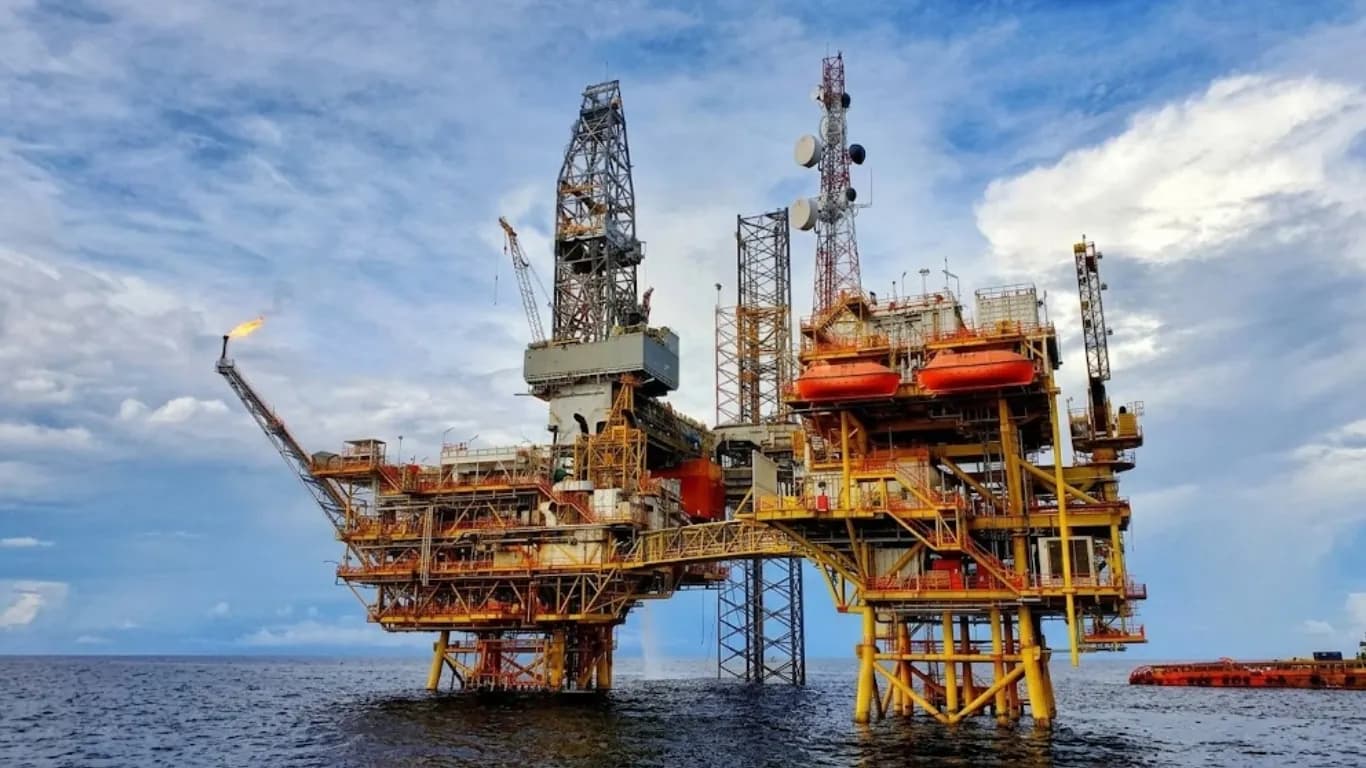
It became the downtown district of an offshore city.
A city that would eventually include Mumbai High, Heera, Neelam, Bassein, Panna-Mukta, Tapti, hundreds of platforms, thousands of kilometres of subsea pipelines, helicopter networks, offshore support vessels, processing complexes and some of the most challenging engineering ever attempted by India.
This is the story of that city , its birth, its crises, its reinvention and what is being built right now in 2026.
518.7 million tonnes of oil. 216.84 billion cubic metres of gas.
That is what Mumbai High has produced across its lifetime , from a single offshore structure, 160 kilometres into the Arabian Sea, discovered in 1974.
For context: that cumulative oil production exceeds the entire proven reserves of several OPEC member nations.
As of January 2026, Mumbai High still produces 126,000 barrels per day, and ONGC Chairman A.K. Singh has publicly committed to a major production boost from the field by October 2026.
This is not a field in its final chapter.
This is a field being actively rebuilt.
By the late 1960s, India imported the majority of its crude requirement. Foreign exchange reserves were being consumed at a rate the economy could barely sustain. Domestic oil production existed , but not at the scale a nation of 550 million people required.
Energy security was not a policy concern. It was a strategic emergency.
ONGC had begun mapping India's western offshore basin. Most considered it expensive, technically demanding and far from guaranteed. The organisation had limited offshore drilling experience. The infrastructure barely existed. Skepticism was reasonable.
Exploration teams kept going anyway.
Then came February 1974.
The confirmation of commercial oil came in February 1974 with the drilling of ONGC's first exploratory well in the structure, designated H-1-1, drilled using the drillship Sagar Samrat, which encountered hydrocarbons in Miocene limestone reservoirs.
The discovery had been preceded by years of seismic mapping. The Mumbai High Field was discovered in February 1974 by ONGC in collaboration with a Soviet exploration team using the seismic vessel Academic Arkhangelsky.
Production started in 1976.
What followed was extraordinary. Mumbai High reached its operational peak a decade later, delivering 400,000 barrels per day and maintained that extraordinary rate for five consecutive years.
For the first time in India's post-independence history, the country could imagine genuine domestic energy production at scale.
The discovery didn't just create a field. It triggered the birth of an offshore industrial city.
The field's geology is a giant carbonate reservoir in 70–90 metres of water. Mumbai High crude has more than 60% paraffinic content , significantly higher quality than Middle Eastern benchmark crudes.
Mumbai High was the anchor. But the city that grew around it was built by three other assets the industry rarely discusses with the depth they deserve.
HEERA | The Asset That Refused To Decline
When people discuss India's western offshore, the conversation almost always starts and ends with Mumbai High.
But offshore professionals know that Mumbai High was never carrying the burden alone.
One of the most important contributors was Heera.
Discovered in September 1977, only a few years after Mumbai High, Heera would eventually become one of ONGC's most productive offshore oil-producing assets. It entered production in November 1984.
What made Heera unique was not its size.
It was its longevity.
The field was developed in relatively shallow waters and initially produced under natural reservoir depletion. By the late 1980s, reservoir pressure decline became a major concern. Engineers faced a choice:
- Accept declining production.
- Or redesign the field's future.
They chose the second option.
Water injection began in 1990 to maintain reservoir pressure and improve sweep efficiency. This would become one of the most significant reservoir management programs in India's offshore sector.
ONGC invested Rs 2,305 crore in Heera and South Heera redevelopment, initiating multiple brownfield phases that kept the field producing for decades beyond its initial design life.
Over the following decades, Heera underwent multiple redevelopment phases:
- New wellhead platforms
- Additional injection wells
- Pipeline modifications
- Improved reservoir modelling
- Enhanced recovery initiatives
The 2026 chapter: ONGC has approved ₹569 crore for additional well platforms at Heera ,specifically to access new production zones and unlock free gas from shallow reservoirs.
42 years after first production. Still being developed.
NEELAM | The Laboratory Of Offshore Reservoir Management
If Heera demonstrated longevity, Neelam demonstrated adaptation.
Neelam entered production in 1989 and quickly became one of the most strategically important offshore assets within the western offshore network.
Unlike early offshore developments that relied primarily on natural drive mechanisms, Neelam became a testing ground for more advanced reservoir management strategies.
Water injection commenced in 1994.
By the early 2000s, ONGC launched a dedicated Improved Oil Recovery (IOR) program for Neelam.
This marked an important shift. The objective was no longer simply producing oil.
The objective became maximizing recovery from every remaining barrel trapped within the reservoir.
The field evolved into a showcase for:
- Pressure maintenance
- Reservoir surveillance
- Waterflood optimization
- Production allocation strategies
- Brownfield redevelopment
Many of the lessons learned at Neelam would later influence redevelopment programs across western offshore assets.
In many ways, Neelam became an engineering classroom located 150 kilometres offshore.
BASSEIN | The Asset That Changed India's Gas Story
Mumbai High made India an offshore oil producer. Bassein made India an offshore gas producer.
Recommended by LinkedIn
That distinction matters. Because gas production is a completely different engineering challenge.
Located 80 kilometres northwest of Mumbai across a 235 square kilometre area in 50–70 metres of water. At its peak, Bassein contributed approximately 43% of ONGC's total gas production , feeding power generation stations, fertilizer plants, petrochemical facilities and industrial clusters across western India for decades.
What made Bassein particularly challenging was the presence of sour gas in parts of the offshore system.
Engineers had to manage:
- Hydrogen sulphide (H₂S)
- Carbon dioxide (CO₂)
- Corrosion risks
- Material compatibility challenges
This forced India to develop expertise in offshore gas processing and sour-service operations. That knowledge would later become critical for future offshore gas developments.
The field was predicted to begin natural decline after cumulative production of 180 BCM. Bassein achieved 200 BCM cumulative production , ranking among the world's super-giant gas fields alongside the Pars field of Iran and Ghavea of Saudi Arabia, with in-place reserves of 11 trillion cubic feet
Today, despite decades of production, Bassein remains one of ONGC's most strategically important gas-producing regions. Along with Mumbai High, it continues to account for a significant share of India's offshore hydrocarbon production.
I previously explored the story of the Bassein Gas Field in my article, "The Bassein Gas Field — The Offshore Story India Never Fully Told." You can read it here: - LINK
Cities need roads. This city built thousands of kilometres of subsea pipelines. Cities need airports. This city built helidecks on every major platform. Cities need logistics. This city built fleets of offshore supply vessels and support bases connecting 160 kilometres of open sea to the mainland.
Mumbai High alone has more than 551 oil wells and 33 gas wells.
The western offshore complex includes Mumbai High, Bassein, Heera, Neelam, Panna-Mukta, Tapti and multiple satellite fields , all interconnected through shared processing capacity, pipeline corridors and offshore logistics infrastructure.
At its height, Mumbai High and Bassein together accounted for almost two-thirds of India's total domestic hydrocarbon production.
A support vessel collided with the Mumbai High North processing complex during severe weather.
The accident caused a production loss of approximately 120,000 barrels of oil and 4.4 million cubic metres of gas per day. Twenty-two offshore workers were killed. A major production platform was destroyed.
The incident forced a complete reassessment of everything: asset integrity management, marine coordination protocols, emergency response architecture, platform safety design and operational redundancy.
The response was not retreat.
ONGC commissioned a replacement Mumbai High North Process Platform at a cost of Rs 6,060 crore , a 13,500-tonne facility that boosted output by 9,000 barrels per day on commissioning and is projected to deliver 55 million tonnes of oil and 6.5 BCM of gas through 2030.
The city rebuilt itself. More resilient than before.
In January 2025, ONGC made the most consequential partnership decision in Mumbai High's history.
ONGC onboarded BP as Technical Services Provider for Mumbai High in February 2025, targeting a 44% increase in oil production and an 89% jump in gas output , unlocking up to $15 billion in incremental revenue over 10 years.
BP beat Shell in a competitive bidding process. The prize: the world's longest-producing major offshore field and one of Asia's most strategically important energy assets.
Early results are already measurable. As of January 2026, the ONGC-BP partnership has delivered 3,500–4,000 additional barrels per day of oil and approximately 2.5 million standard cubic metres per day of incremental gas. The production low point , reached in July/August 2025 , has reversed. Director of Production Pankaj Kumar confirmed: "The decline has stopped and we have only seen uptick."
ONGC Chairman A.K. Singh has publicly committed to a major production boost from Mumbai High by October 2026.
The Recovery Factor Gap - Where The Real Value Sits
Mumbai High's current recovery factor stands at approximately 28.6% , significantly below the 45%+ achieved at Norway's Ekofisk, a comparable offshore carbonate field.
Achieving a 40% recovery factor would represent approximately 205 million additional tonnes of oil beyond the current baseline , accessible through existing offshore infrastructure.
The gap between 28.6% and 40% is not a geological problem. It is an engineering and technology deployment problem.
That is exactly the problem BP was contracted to solve.
The AI Transformation
ONGC is simultaneously executing one of the most ambitious digital transformations in its history.
ONGC Chairman Arun Kumar Singh stated that ONGC's AI systems now achieve 98.5% accuracy in well location identification. "Unless you are centralised, you can't be digitalised. And unless you are digitalised, you can't bring efficiency in the system."
ONGC has signed a ₹125 crore three-year AI digital transformation programme with CIPL , a total operational overhaul focused on intelligent field management, faster decision-making and cybersecurity hardening across the entire offshore asset base.
ONGC is investing in digital twins , virtual replicas of physical assets that allow simulation and testing of operational scenarios before real-world implementation , directly applied to Mumbai High reservoir management.
New Discoveries in 2025 — The City Is Still Expanding
In 2025, ONGC announced two significant oil and gas discoveries in the Mumbai Offshore basin adjacent to Mumbai High: Suryamani in the OALP-VI block and Vajramani in the OALP-III block.
New districts. Same city.
Closing Thought
Fifty years ago, engineers built an offshore city from steel and Miocene limestone.
They drilled through rock 160 kilometres from the coast with technology that, by today's standards, was primitive. They built platforms in the monsoon Arabian Sea when most of the world still considered Indian offshore engineering a developing capability. They connected it all with subsea pipelines through one of the most active cyclone corridors in the world.
Then, when the easy production was over, they didn't walk away.
They designed water injection programmes. They drilled new wells into bypassed reservoirs. They rebuilt platforms after disasters that killed their colleagues. They invested tens of thousands of crores across five successive redevelopment campaigns. They brought in BP to unlock recovery factors that comparable Norwegian fields achieved decades earlier.
518.7 million tonnes of oil. 216.84 billion cubic metres of gas.
And rising.
Heera taught India how to sustain production from a field the numbers said should have stopped.
Neelam taught India how to recover more from reservoirs conventional thinking would have left behind.
Bassein taught India how to build an offshore gas economy from scratch in one of the most technically demanding marine environments in the world.
Together, they didn't just power India.
They built the engineering knowledge base , in reservoir management, brownfield redevelopment, offshore logistics, structural integrity and now AI-assisted operations , that will determine whether India's next offshore chapter succeeds.
The offshore city is fifty years old. It is not retiring. Its largest production boost in years is expected by October 2026.
And the greatest chapters may still be ahead.
Mumbai High is 52 years old and still being redeveloped. Which mature offshore asset do you think is the most underrated engineering story the industry isn't talking about?
Happy Reading!