If Sagar Samrat was India’s offshore entry, Mumbai High was India’s offshore economy.
Because this wasn’t just a discovery.
It became a system: platforms, pipelines, processing trains, water injection, gas lift, logistics, power, safety, and decades of reinvention under live production.
And that’s why Mumbai High still deserves study today: it taught India how to operate offshore at scale, not just drill offshore once.
Where it is — and why that matters
Mumbai High (still widely remembered as Bombay High) sits in the Arabian Sea, roughly 160 km west–north-west of Mumbai, in about ~80 m water depth.
That “80 m” detail is not trivia.
It explains why India’s offshore story became a shallow-water mega-development first: shallow enough for jack-ups and fixed platforms, yet harsh enough that every mistake becomes expensive.
The moment that shifted India’s energy trajectory
Discovered in February 1974, and brought into production in 1976, Mumbai High became the backbone of India’s western offshore story.
But the real reason it matters isn’t just the discovery date.
It’s what happened after discovery , the engineering scale-up, the platform ecosystems, the pipelines, the processing complexes, the discipline of operating a mature giant field for decades.
Mumbai High taught India how to run offshore like a serious energy nation.
Why Mumbai High was a different kind of discovery
Mumbai High wasn’t “one more offshore find.” It was a giant, multi-decade producing system ,the kind that forces a country to build capability end-to-end:
- seismic and subsurface interpretation
- drilling programs at scale
- platform design and fabrication
- marine logistics
- power generation, utilities, and safety systems
- production handling and evacuation pipelines
- brownfield upgrades without stopping output
This is why the field’s impact went far beyond barrels. It created an offshore operating culture.
A field built as an ecosystem, not a single platform
People often picture offshore as “a rig in the sea.”
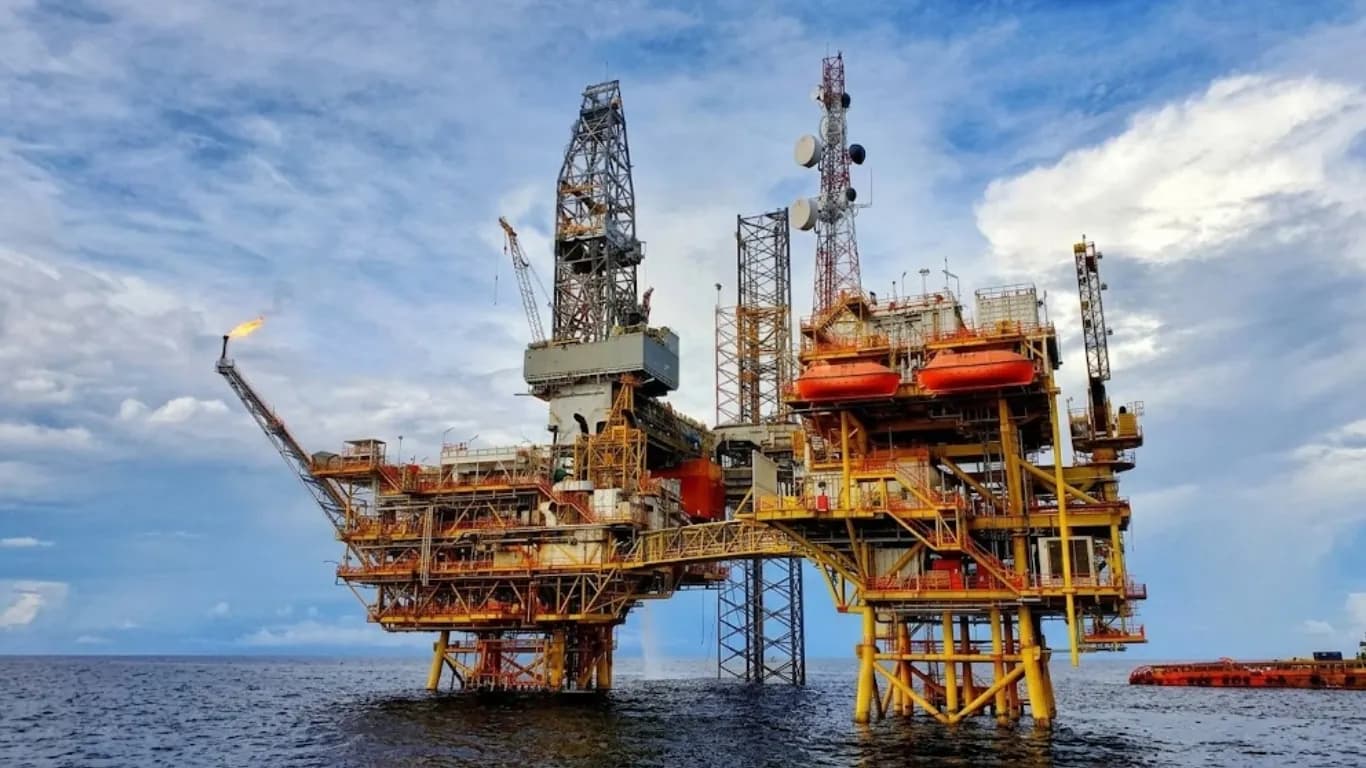
Mumbai High is the opposite of that simplification. It’s a network of installations and processing , built in phases, expanded, upgraded, and reworked repeatedly as the field matured.
Even publicly available facility summaries describe Mumbai High North as a complex of multiple bridge-linked platforms with different roles (wellhead, residential, processing), illustrating how the field is designed as a system-of-systems rather than one structure.
That architecture is why Mumbai High could scale , and why it has remained relevant long after its early peak.
The production reality: from peak to maturity
Mumbai High hit its historic highs decades ago. One widely cited figure is a peak oil output of around 471,000 barrels/day in the mid-1980s/peak era.
Like every mature giant field, production declined over time , and that’s normal.
What’s not normal is staying strategically important for 50 years.
Recent technical reporting places current production around ~134,000 barrels/day (after long decline), and explicitly frames Mumbai High as a mature asset being targeted for output enhancement using advanced recovery and mature-field expertise.
This is the real engineering story:
Mumbai High didn’t stay alive because it was easy. It stayed alive because it was continuously re-engineered.
Production History Table
Why “Mumbai High” is a masterclass in offshore asset management
If you want to study how offshore assets survive decades, Mumbai High gives you the playbook. Mature fields don’t fail because oil disappears overnight. They fail because systems age:
- corrosion and structural fatigue
- obsolescence in control and protection systems
- instrument drift and unreliable signals
- gas handling constraints
- declining reservoir pressure and complex water cut behavior
- power stability issues and emergency response readiness
And at a field scale, the problem isn’t “one failure.” It’s coordination: getting dozens of subsystems to behave correctly under stress.
Redevelopment & 2026 Relevance — Why Mumbai High Is Still Being Re-Engineered, Not Replaced
Mumbai High’s relevance in 2026 is not about discovering new oil. It is about recovering what decades of production left behind , safely, economically, and without destabilizing a live offshore system.
Recommended by LinkedIn
By the late 2000s, Mumbai High had clearly entered a mature-field phase:
- Natural reservoir pressure had declined
- Water cut increased across multiple well clusters
- Legacy waterflood patterns were no longer optimized
- Platform systems were operating far beyond their original design life
In response, ONGC launched multiple redevelopment phases, with Phase-II (post-2009) alone contributing 17+ million tones of incremental oil through:
- New infill wells
- Pattern re-alignment
- Improved water injection management
- Progressive brownfield modifications under live production
This was not decline arrest by drilling alone. It was reservoir + surface + systems engineering acting together.
Why BP Was Brought In — And Why ONGC Retained Control
In 2025, ONGC engaged BP as a Technical Services Provider (TSP) for Mumbai High — a non-equity, performance-linked model, not a farm-out or operatorship transfer.
That distinction matters.
ONGC retained full ownership and operational control because:
- Mumbai High is a strategic national asset, not a commercial divestment candidate
- The field’s complexity lies in mature-reservoir behaviour, not basic execution
- ONGC already possesses offshore operating capability; what it sought was specialised mature-field optimisation expertise
BP’s role is therefore sharply defined:
- Advanced reservoir modelling and simulation
- Optimisation of low-salinity waterflooding
- Data-driven recovery strategies using AI-assisted production analytics
- Performance-linked incentives tied to incremental output, not asset control
This model reflects a broader global shift:
National oil companies no longer outsource assets. They selectively import expertise .
Enhanced Oil Recovery: Where the Real Battle Is Now
By 2026, Mumbai High’s recovery challenge is no longer geological uncertainty — it is sweep efficiency and system coordination.
Key focus areas include:
- Low-salinity water injection to improve microscopic displacement efficiency
- Re-balancing injector-producer patterns to manage uneven water breakthrough
- Integrating real-time production data with reservoir models
- Managing gas handling and compression constraints as fluids evolve
In mature offshore fields, EOR success depends less on theory and more on:
- Injection reliability
- Flow assurance
- Platform uptime
- Control system behaviour during transients
This is why redevelopment timelines extend to 2026 and beyond , not because progress is slow, but because every change must coexist with ongoing production.
Quick Snapshot: Mumbai High
- Operator: ONGC
- Discovery: 1974
- Start of production: 1976
- Location: ~160 km off Mumbai, Arabian Sea
- Peak oil (reported): ~471,000 bpd
- Current oil (reported, ~2024): ~134,000 bpd
Final reflection: why Mumbai High still matters
Mumbai High is not just “India’s largest offshore field.” It is India’s offshore operating school.
It forced the country to learn what offshore really demands:
- engineering under uncertainty
- maintenance under salt, vibration, and continuous duty
- system integration where failures cascade fast
- safety systems that must work in seconds, not in paperwork
- upgrades where the biggest enemy is not hardware — it’s behavior under real conditions
Mumbai High didn’t just change production numbers. It changed India’s engineering confidence.
And for anyone studying ONGC assets seriously, this is the key lesson:
Offshore greatness isn’t built on discovery alone. It’s built on sustaining performance for decades — quietly, relentlessly, and at scale.
Happy Reading!
References
- Technical summary and key field facts (location, discovery, production start, peak figures) LINK
- Discovery timeline context and basin note. LINK | Mumbai Offshore Basin PDF
- 50-year anniversary reporting and cumulative production context. LINK
- Mature-field boost plans and production figures (BP/ONGC reporting). LINK | LINK
- ONGC expects oil production boost at Mumbai High by Oct 2026. LINK