
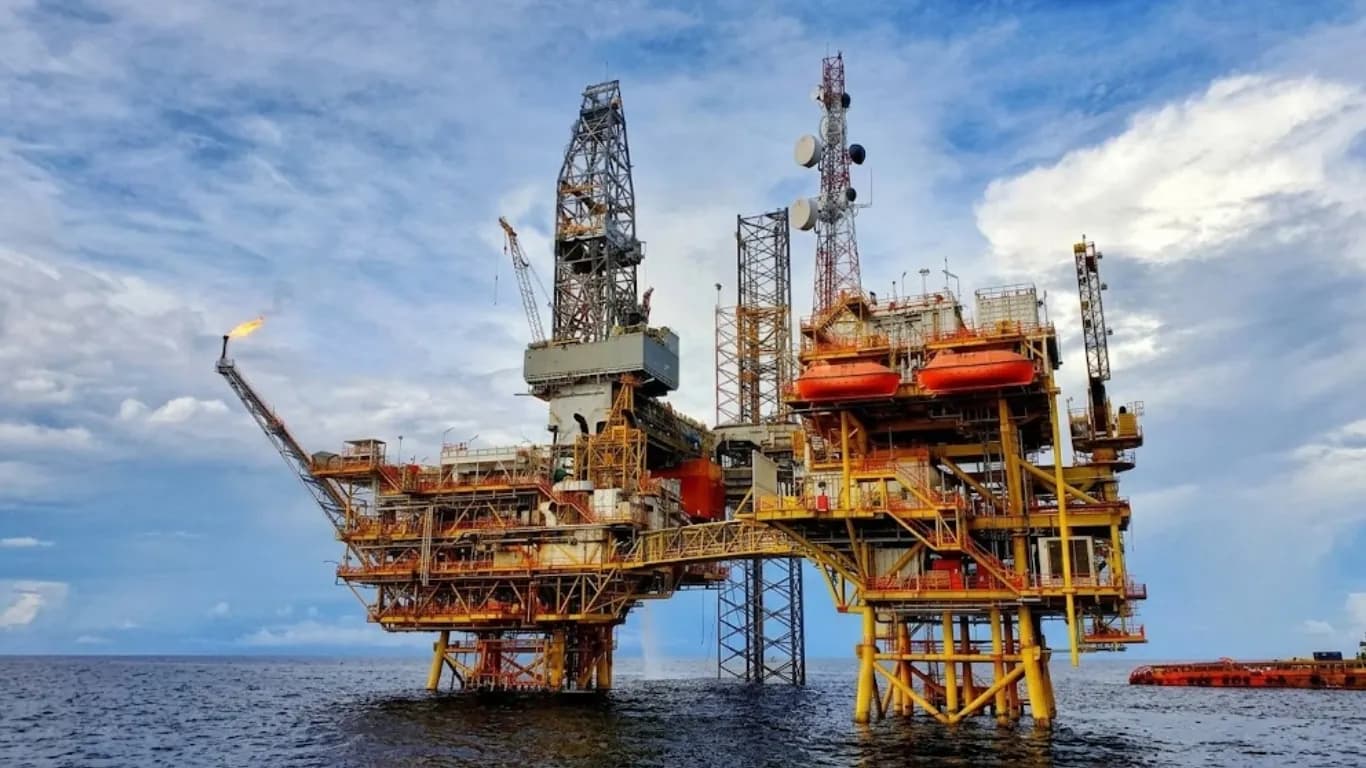
How India spent a decade opening offshore acreage, rebuilding its exploration framework and reducing frontier risk before approving an ₹84,084-crore offshore exploration mission.
On 18 September 2026, ONGC encountered natural gas in well MN-DW18-1-H-D in the Mahanadi Offshore Basin, approximately 43 km off Konark on India's east coast. The well reached a target depth of 1,623 metres and recorded gas in the 1,441–1,452 metre interval. ONGC's announcement on 21 September described the location as potentially favourable for early monetisation, but importantly qualified that possibility as subject to further appraisal and commercial evaluation.
The obvious history of this well begins on 25 July 2026, when drilling commenced, or perhaps six days later, when the Union Cabinet approved Samudra Manthan - the National Offshore Exploration Scheme - with an outlay of ₹84,084 crore.
Both dates begin too late.
By the time the ₹84,084-crore scheme received Cabinet approval, India had already spent years changing the conditions under which offshore exploration could happen: reopening previously restricted acreage, reforming licensing, acquiring new seismic data, consolidating historical subsurface information, drilling stratigraphic wells, building dedicated deepwater capability and accumulating new geological evidence in basins such as Mahanadi.
The Cabinet decision did not begin that process. It gave an already developing exploration strategy the financial architecture to operate at a much larger scale.
Samudra Manthan is better understood as the culmination of a much longer attempt to solve four interconnected problems in Indian offshore exploration: acreage that could not be accessed, geology that was insufficiently understood, deepwater wells whose risk-adjusted economics discouraged exploration, and discoveries that could remain commercially stranded without shared infrastructure.
The mission announced in 2025 and funded in 2026 did not create India's offshore exploration strategy. It assembled several years of policy, geological and institutional changes into a single national programme.
That distinction matters, because the gas encountered off Konark is not yet evidence that an ₹84,084-crore programme has succeeded. It is evidence from one well in a much larger experiment designed to determine how much of India's offshore geological potential can ultimately become commercially recoverable oil and gas.
- 2016 - Hydrocarbon Exploration and Licensing Policy (HELP) introduced
- 2017 - National Data Repository established
- 2022 onward - major offshore No-Go restrictions progressively removed
- By 2024 - restrictions removed from approximately 99% of erstwhile No-Go offshore acreage
- 15 August 2025 - National Deep Water Exploration Mission announced
- 25 July 2026 - first Mahanadi appraisal well in the four-well programme spudded
- 31 July 2026 - ₹84,084-crore Samudra Manthan scheme approved
- 18 September 2026 - gas encountered at MN-DW18-1-H-D
- September 2026 - the programme moves from policy architecture into its first new cycle of geological evidence.
The 60-well scheme is definitely official: the Cabinet approval allocates ₹43,200 crore for 60 deepwater exploration wells, with support of up to 50% of eligible drilling cost or ₹675 crore per well.
India's case for increasing domestic hydrocarbon exploration is usually framed through import dependence. The government's Samudra Manthan note places the annual crude-oil import bill at approximately $144 billion, or ₹13 lakh crore.
But the upstream problem is more complicated than replacing imports.
Existing oil and gas fields decline. Government material puts natural decline from producing fields at approximately 6–7% annually. New production therefore has to compensate for depletion before it can create significant net growth. At the same time, much of the remaining offshore opportunity lies in progressively more difficult environments. The government estimates that a deepwater exploratory well can cost roughly $125–150 million.
This creates a difficult exploration equation. The areas capable of materially expanding the resource base can also be among the most expensive places to establish that nothing commercially useful is present.
For years, however, cost was not the only constraint. Large parts of India's offshore domain were not fully available for exploration at all.
Substantial offshore acreage had historically remained within so-called No-Go areas, where exploration was restricted because of requirements associated with defence, space and other agencies.
That changed progressively.
By 2024, the government reported that restrictions had been removed from approximately 99% of the erstwhile No-Go offshore area. Bids or expressions of interest had already been received for 152,325 sq km of released acreage. The Andaman offshore was also reopened for exploration following removal of restrictions imposed by defence and space agencies in 2022.
The significance of that decision became visible relatively quickly in Mahanadi.
Two ONGC gas discoveries were reported in a Mahanadi offshore block in which approximately 94% of the acreage had previously fallen within the No-Go classification.
This is an important part of Samudra Manthan's ancestry because it demonstrates that the exploration problem was not exclusively one of geology.
Some geological hypotheses had simply not been tested adequately because the acreage itself was inaccessible.
Opening the acreage removed one constraint. It did not answer what lay beneath it.
For that, India needed data.
The second foundation had been laid earlier.
India introduced the Hydrocarbon Exploration and Licensing Policy (HELP) in 2016 and subsequently moved to the Open Acreage Licensing Programme (OALP). The broader objective was to make exploration acreage more continuously accessible and allow companies greater flexibility in identifying areas they considered prospective.
By July 2026, the scale of the change was measurable.
The government reported that approximately 81% of India's active exploration acreage had been awarded after 2014. Under OALP, 172 blocks covering nearly 3.8 lakh sq km had been awarded, carrying committed investment exceeding $4.3 billion. During FY2025-26, around 674 wells were drilled across India's exploration and production sector; five discoveries were made and seven discoveries were monetised.
Those figures put Samudra Manthan in a different context.
The mission did not arrive on top of the upstream landscape India had at the beginning of the century. By 2026, both the acreage available for exploration and the framework through which it could be awarded had changed substantially.
The remaining question was whether the subsurface knowledge had improved enough to justify drilling expensive frontier wells.
Frontier exploration starts with an information problem.
An operator needs to understand basin architecture, sediment thickness, source rocks, migration pathways, reservoir distribution, trapping mechanisms, pressure regimes and numerous other geological variables before deciding that a prospect justifies a well that may cost more than $100 million.
That is why several programmes preceding Samudra Manthan matter to its history: the
- National Seismic Programme
- Mission Anveshan,
- The National Data Repository
- Hydrocarbon resource reassessment
- Offshore seismic acquisition and
- Government-funded stratigraphic drilling.
By 2024, the government said it was spending approximately ₹7,500 crore on seismic acquisition and stratigraphic wells to improve knowledge of Indian sedimentary basins. Within that programme, ₹3,200 crore was allocated for four offshore stratigraphic wells in the Mahanadi, Bengal, Saurashtra and Andaman basins.
The National Data Repository, established in July 2017, added another layer: preservation and dissemination of seismic, well and production data so that information generated by decades of exploration could be reused in subsequent acreage evaluation.
This is the less visible history behind Samudra Manthan.
Before India decided to subsidise more drilling, it had already begun spending public money to reduce the uncertainty surrounding where to drill.
This is particularly important in interpreting the September 2026 result.
Mahanadi is not a virgin offshore basin in which ONGC happened to drill a well and unexpectedly encounter gas. The Directorate General of Hydrocarbons classifies it as a Category-II basin, meaning hydrocarbons have been discovered but commercial productivity at basin scale has not yet been established.
The basin covers approximately 99,500 sq km, of which almost 69,789 sq km is deepwater acreage. DGH identifies eight plays across Cretaceous-Tertiary sequences and has historically highlighted sparse information in deeper and deepwater plays as one of the basin's major exploration limitations.
Its petroleum system is also not uniform.
DGH records several biogenic gas accumulations, while thermogenic accumulations have also been established. Hydrocarbon occurrences extend across Tertiary sequences from Paleogene to Miocene-Pliocene. In the deepwater sector, discovered Miocene plays include discrete and stacked reservoirs, while prospective Pliocene plays are associated with biogenic gas. DGH specifically identifies high-resolution seismic for deeper-play delineation and pore-pressure analysis in high-pressure areas as important to future exploration.
That geological complexity explains why simply describing Mahanadi as “gas-rich” would be premature.
The important question is not whether hydrocarbons have been generated somewhere in the basin. They have.
The commercial question is whether sufficiently large, connected and productive reservoirs can be delineated and developed economically.
Before the current well, ONGC had already made the Utkal Krishna and Konark discoveries in Mahanadi offshore.
A 2024 DGH technical presentation gives unusually useful detail. The two relevant blocks, MN-DWHP-2018/1 and MN-UDWHP-2022/1, cover approximately 12,288.64 sq km. Well MDW-27 at the Utkal Krishna discovery produced gas at approximately 300,341 standard cubic metres per day, while MDW-26 at Konark produced around 458,629 standard cubic metres per day.
The same technical material also records the complications: heterogeneous sands, limited structural elements affecting reservoir distribution and trapping, questions around local charging mechanisms, and the need to distinguish biogenic from thermogenic gas as exploration moves deeper.
Those details change the story.
By 2026, ONGC was no longer asking the most elementary question - does Mahanadi contain gas?
The increasingly important question was whether repeated discoveries could establish commercial scale.
That is why the official description of the July 2026 well deserves attention.
The Petroleum Ministry called MN-DWN18-1-HD an appraisal well and identified it as the first of four planned deepwater wells intended to evaluate the basin systematically.
In other words, the current drilling campaign sits within an accumulating geological argument rather than beginning one from scratch.
At the same time, India was testing much less mature offshore geology
Mahanadi represents only one part of the strategy.
India's offshore portfolio spans basins at very different stages of geological understanding and commercial maturity. The Krishna-Godavari Basin already contains established deepwater production. Mahanadi contains discoveries but remains Category II. The Andaman Basin represents a much more frontier exploration proposition.
That difference is important because Samudra Manthan is not one giant oil field project.
It is a portfolio of geological tests.
The rationale for drilling in a basin with established petroleum systems is different from the rationale for drilling a stratigraphic well in a frontier basin. A stratigraphic well may primarily improve understanding of the basin, its sedimentary sequence, source-rock potential, reservoir presence and petroleum-system behavior, rather than immediately establish a commercial development.
This is why the government-funded stratigraphic programme and the opening of Andaman acreage belong in the Samudra Manthan story. India was attempting to reduce basin-scale uncertainty, not merely increase the annual well count.
On 15 August 2025, Prime Minister Narendra Modi announced from the Red Fort that India would pursue a National Deep Water Exploration Mission, using the metaphor “Samudra Manthan” for the search beneath India's seas.
The Cabinet's subsequent approval explicitly traces the 2026 scheme back to that Independence Day announcement.
But by August 2025, many of the programme's foundations already existed.
No-Go acreage was being released. OALP had expanded the exploration map. The National Data Repository was operating. Government-funded seismic and stratigraphic programmes were underway. Mahanadi had produced new discoveries. And frontier basins were receiving renewed attention.
The 2025 announcement therefore did something different.
It brought those strands together under a mission-mode offshore exploration strategy.
The distinction is useful:
Samudra Manthan was announced in 2025. Its geological and policy foundations were built earlier.
From dispersed exploration to a dedicated deepwater mission
ONGC's DeepX initiative represents the institutional side of the same transition.
The underlying problem is familiar to any long-established exploration company. Decades of operations generate enormous quantities of seismic data, well logs, pressure information, geological interpretations and drilling experience. But possessing information is not the same as integrating it effectively across assets and basins.
DeepX was designed around a “One Company, One Data” philosophy, bringing specialist deepwater capability and accumulated subsurface knowledge into a more mission-oriented framework.
Its significance should not be overstated before results can be measured. A new organisational structure does not reduce geological uncertainty by itself.
But the logic is clear: if India intended to increase deepwater drilling materially, ONGC needed to increase not only the number of wells but also the rate at which information from one well could alter decisions on the next.
At a programme scale approaching 150 deepwater wells over roughly seven years, that learning cycle becomes economically important.
One mission, two well numbers
Two numbers associated with India's deepwater push can easily be confused.
The 60 wells belong specifically to the ₹84,084-crore National Offshore Exploration Scheme. The government has allocated ₹43,200 crore to support 60 deepwater exploration wells through FY2030-31.
The 150-well figure belongs to the broader multi-year deepwater drilling ambition associated with ONGC's DeepX programme.
They therefore describe different layers of the offshore push and should not be treated as interchangeable.
60 wells = the government-supported scheme.
150 wells = the broader operator-level deepwater ambition.
That distinction will become particularly important when progress against Samudra Manthan is eventually measured.
The 60-well side is explicitly confirmed by the Cabinet release.
The chronology becomes particularly revealing in July.
On 25 July 2026, drilling of MN-DWN18-1-HD commenced in the Mahanadi Offshore Basin. The Petroleum Ministry described it as the first appraisal well in a four-well deepwater programme.
Six days later, on 31 July, the Union Cabinet formally approved Samudra Manthan - the National Offshore Exploration Scheme as a Central Sector Scheme of the Ministry of Petroleum & Natural Gas, with implementation through FY2030-31.
The sequence is instructive.
It shows that the Cabinet approval did not mark the moment at which offshore exploration suddenly began. The operational programme and its underlying geological work were already moving.
The ₹84,084-crore approval instead created a financial and institutional architecture intended to accelerate that activity at a much larger scale.
And the composition of the ₹84,084 crore is considerably more revealing than the total.
The scheme allocates ₹28,534 crore to modern offshore seismic data acquisition and processing.
Another ₹43,200 crore is allocated to drilling 60 deepwater exploration wells, with government assistance of up to 50% of eligible drilling expenditure or ₹675 crore per well, whichever is lower.
A further ₹10,000 crore is allocated to common offshore infrastructure intended to facilitate commercialisation of discoveries, while ₹2,000 crore is earmarked for Oil and Gas Manufacturing and Services Zones. The remaining programme support brings the overall approved outlay to ₹84,084 crore.
Read as a budget, these are expenditure lines.
Read as an exploration strategy, they identify the problems the government believes need solving:
That is why describing Samudra Manthan merely as an ₹84,084-crore drilling programme misses much of its design.
It attempts to intervene from geological de-risking through eventual commercialization.
Recommended by LinkedIn
The offshore push is already extending beyond ONGC
Samudra Manthan should not be read exclusively as an ONGC story.
Oil India has also been building a deepwater and ultra-deepwater position. Its current portfolio includes two ultra-deepwater blocks in the Krishna-Godavari Basin and two in the Mahanadi Basin, alongside offshore acreage elsewhere.
More importantly, this is no longer visible only on an acreage map.
By September 2026, Oil India had moved into procurement for the operating infrastructure required to drill those blocks. Current tenders include two DP-3 drillships capable of operating in water depths from 500 to 3,000 metres, bundled drilling services for four Mahanadi and KG ultra-deepwater blocks, offshore helicopter support and an offshore supply vessel.
That is significant because it provides another way to judge whether Samudra Manthan is becoming an offshore exploration ecosystem rather than a single-company drilling campaign.
The larger test is therefore not simply whether ONGC drills more wells.
It is whether sustained exploration begins mobilising multiple operators, drillships, offshore logistics, subsurface specialists, service companies, technology providers and eventually domestic manufacturing around India's offshore basins.
This is actually better evidence than simply quoting a ₹15,000-crore OIL investment headline, because we can see concrete procurement activity happening now.
The economics of frontier exploration
The most unconventional component is the government's willingness to share deepwater drilling cost.
The reason becomes clearer when a single exploratory well may cost $125–150 million.
An operator drilling a frontier well bears the direct financial consequence if the well is dry. But the geological information generated by that well can improve understanding of an entire basin and influence subsequent exploration by other participants.
There is therefore a difference between the private economic value of one well and the national informational value of systematically testing an underexplored basin.
Samudra Manthan's cost-sharing mechanism effectively places public value on closing that information gap.
That does not make every well economically justified. Nor does it remove the need to scrutinise finding costs and exploration efficiency.
It does explain why a government seeking more frontier exploration might be unwilling to leave the entire dry-hole risk with individual operators.
5,600 MMTOE is where terminology becomes critical
The headline geological number associated with ONGC's broader deepwater ambition is approximately 5,600 MMTOE of deepwater and ultra-deepwater hydrocarbon potential.
That number should not be read as reserves.
Geological potential, prospective resources, discovered resources, contingent resources, reserves and production describe very different stages of the petroleum-resource chain.
The formal Samudra Manthan scheme illustrates the distinction. The formal scheme states that, subject to exploration success, it aims to expand India's hydrocarbon resource base from approximately 1.6 billion TOE to 2.2 billion TOE, while increasing annual domestic oil and gas production from approximately 62 MMTOE to 80 MMTOE.
The 5,600-MMTOE potential and the roughly 600-MMTOE targeted addition therefore should not be presented as competing estimates of the same thing.
They represent different points in an exploration funnel.
A large geological possibility must first become a prospect. A prospect must survive drilling. A discovery must survive appraisal. Technically recoverable hydrocarbons must survive commercial evaluation. A commercial discovery must then survive development economics before becoming reserves and, eventually, production.
The purpose of Samudra Manthan is essentially to move more offshore acreage through that funnel.
How much survives is unknown.
That brings the chronology back to MN-DW18-1-H-D.
On 18 September, ONGC encountered gas in the 1,441–1,452 metre interval after drilling to a target depth of 1,623 metres. The well is approximately 43 km offshore from Konark. ONGC indicated that its relative proximity to shore could support early monetisation, subject to further appraisal and commercial evaluation.
The result matters because it adds another hydrocarbon occurrence to a basin in which Utkal Krishna and Konark had already strengthened the Pliocene gas play.
But it does not yet answer the questions that determine whether a discovery becomes an asset.
The next stage must establish reservoir extent and continuity, recoverable volumes, sustainable productivity and development economics. The relationship between the recent accumulations also matters because several discoveries capable of sharing facilities can have very different economics from several isolated accumulations requiring separate infrastructure.
This is where the scheme's ₹10,000-crore common-infrastructure component becomes relevant.
The geological objective and the infrastructure policy are potentially converging on the same commercial problem: how to convert multiple offshore discoveries into an economically developable cluster rather than leave them as individual subsurface successes.
That possibility remains to be demonstrated.
What has genuinely changed — and what has not
There is a defensible argument that the environment in which India is undertaking this programme is materially different from earlier exploration cycles.
The exploration map is larger. Almost all former offshore No-Go acreage has been released. HELP and OALP have altered acreage access. The National Data Repository has consolidated decades of information. Government-funded seismic and stratigraphic programmes have expanded the geological dataset. Mahanadi has produced recent discoveries. Dedicated deepwater capability is being concentrated through DeepX. The government is sharing part of the financial exposure of frontier wells and attempting to reduce development thresholds through common infrastructure.
These changes matter.
But they address different kinds of risk.
Better seismic can reduce interpretation risk.
More historical data can reduce information risk.
Modern drilling technology can reduce execution risk.
Government support can reduce financial exposure.
Common infrastructure can reduce the economic threshold for development.
None of them removes geological risk.
A basin can still disappoint. A reservoir can be smaller, thinner or less connected than expected. A discovery can flow hydrocarbons and remain uneconomic. A technically successful well can therefore still produce an unsuccessful commercial outcome.
That is the tension at the centre of Samudra Manthan.
Mahanadi cannot answer the Andaman question
Another reason to avoid judging the programme from the September result is the geological diversity hidden beneath the national mission.
Mahanadi, Krishna-Godavari, Cauvery and Andaman do not represent repetitions of one petroleum system.
DGH places Mahanadi in Category II, with discovered but sub-commercial in-place hydrocarbons and a substantial deepwater sector.
Andaman presents a more frontier proposition. DGH technical work has identified prospective biogenic gas indicators in West Andaman's Upper Miocene-Pliocene section using seismic attributes, AVO analysis and geological modelling, while explicitly stressing the need for further de-risking and new seismic acquisition.
A commercial Mahanadi development would therefore validate part of the Mahanadi geological and economic model.
It would not validate Andaman.
That is why the eventual Samudra Manthan scorecard has to be basin-specific, not merely national.
The programme has an industrial objective as well as a geological one
The ₹2,000-crore allocation for Oil and Gas Manufacturing and Services Zones introduces another dimension.
India is not only trying to discover hydrocarbons. The scheme also seeks to localise more of the equipment and services required to explore and develop them.
Those are related but separate outcomes.
A programme could discover substantial hydrocarbons while continuing to depend heavily on international drillships, subsea technology and specialised services.
Conversely, a long exploration programme could strengthen domestic offshore engineering capability even if geological results prove less successful than expected.
Samudra Manthan therefore carries at least three overlapping tests:
- Geological: Can the targeted basins produce sufficiently large commercial discoveries?
- Economic: Can those discoveries be developed competitively and brought to production?
- Industrial: Can India capture more of the technology, manufacturing and services value created by a sustained deepwater programme?
There may therefore be a fourth useful measure:
Ecosystem: Does sustained offshore activity attract multiple operators and create enough continuity of demand for drilling contractors, offshore logistics, subsea services, engineering companies and domestic manufacturers to invest around the programme?
The distinction matters. A country can drill a large number of wells through episodic procurement without necessarily creating a durable offshore industrial ecosystem. The stronger outcome would be a sufficiently predictable exploration pipeline for capability itself to become permanent.
Success in one does not automatically guarantee success in the others.
The case for scale
There is nevertheless an important advantage in moving from isolated wells to a sustained exploration programme.
Exploration knowledge compounds.
A dry well can eliminate a geological hypothesis. A pressure measurement can alter the next well design. A reservoir encountered farther downdip can change estimates of a play's extent. Seismic can be reinterpreted after drilling provides ground truth. Discoveries can alter infrastructure planning across neighbouring acreage.
At sufficient scale, therefore, 150 wells are not merely 150 independent bets.
They can become a sequence of progressively informed experiments—provided the information from each well is captured quickly and used to change subsequent decisions.
That is where DeepX, the National Data Repository and the programme's seismic component potentially become as important as the drillships themselves.
The economic test will be whether that learning curve improves discovery efficiency faster than expenditure accumulates.
The case for caution is equally strong
Deepwater history globally and in India provides ample reason not to confuse drilling activity with commercial success.
Resource estimates change after appraisal. Reservoir connectivity can disappoint. Flow rates can fail to sustain early expectations. Development costs can make technically recoverable hydrocarbons commercially marginal. Infrastructure can delay monetisation. Frontier discoveries can spend years between first hydrocarbon and first production.
Samudra Manthan's architecture addresses several of these constraints.
It cannot abolish them.
Nor should one Mahanadi gas encounter be asked to prove more than the evidence supports. A gas-bearing interval establishes hydrocarbon presence. Appraisal must establish reservoir extent, connectivity, recoverable volumes and sustainable productivity. Commercial evaluation must then determine whether those hydrocarbons can become an economically developable asset.
The appropriate conclusion at this stage is therefore neither celebration nor scepticism.
It is measurement.
The number of wells drilled will be the easiest metric to report. It may be one of the least informative on its own.
Over the programme's life, a more useful assessment would track:
- exploration wells versus appraisal wells;
- discovery and dry-hole rates by basin and play;
- discovered resources and ultimately booked reserves;
- finding cost per barrel of oil equivalent;
- commercial discoveries relative to total wells drilled;
- discoveries progressing to Field Development Plans;
- time from discovery to development sanction;
- time from sanction to first production;
- utilisation of common offshore infrastructure;
- private exploration capital mobilised alongside government support;
- domestic manufacturing and oilfield-service capability created;
- incremental oil and gas production actually delivered.
These measures separate exploration activity from exploration productivity.
They also distinguish something even more important: discovering hydrocarbons from creating an energy asset.
From offshore potential to offshore production
The history of Samudra Manthan therefore begins well before the phrase itself entered India's energy vocabulary.
It begins with offshore acreage that could not be explored. It continues through HELP and OALP, the removal of No-Go restrictions, the National Data Repository, government-funded seismic acquisition, stratigraphic drilling and the gradual accumulation of evidence in basins such as Mahanadi. The 2025 announcement converted those developments into a national mission; DeepX and ONGC's expanded drilling programme added an institutional and operational layer; the July 2026 Cabinet decision supplied the financial architecture.
The September gas encounter is the newest point on that continuum.
It is important because it adds subsurface evidence to a Mahanadi story already containing Utkal Krishna and Konark, and because further appraisal may establish whether those discoveries can support a commercially meaningful cluster.
But the deeper significance of Samudra Manthan lies elsewhere.
India is attempting to move offshore exploration away from a sequence of isolated, high-cost geological bets and towards a basin-scale system in which acreage access, seismic data, drilling, information sharing, risk capital, common infrastructure and domestic industrial capability are developed together.
Whether that architecture works cannot be determined by ₹84,084 crore committed, 60 government-supported wells, a broader 150-well drilling ambition or 5,600 MMTOE of geological potential.
Those are inputs, intentions and hypotheses.
The eventual evidence will be found in a different set of numbers: commercial discoveries, recoverable resources, reserves booked, finding costs, development sanctions, time to first production, infrastructure utilisation, domestic capability created and hydrocarbons actually delivered.
MN-DW18-1-H-D has supplied one more piece of geological evidence.
The larger Samudra Manthan thesis remains under test.
And perhaps that is the most accurate way to read the programme in September 2026:
Samudra Manthan wasn't born on 31 July 2026.
India spent the past decade making more of its offshore geology accessible, visible and testable.
It has now committed the capital to test that geology at scale.
The next several years will establish how much of it is commercial.
THE FIRST CHAPTER
This article looks at how Samudra Manthan came into being.
In my earlier article, I looked at the question from the opposite direction: India's previous deepwater experience , Sagar Samridhi, KG-D6 and Deendayal , and what those very different outcomes can teach us before judging the new mission.
Read: Samudra Manthan — 23 Years, Three Big Bets
Happy Reading!