
Middle East Project Case Study | SMEC Oil & Gas Solutions LLC
Quick Definition : A Plant Emergency Shutdown (ESD) System is a dedicated safety system, independent of a plant's standard control system, engineered to bring an industrial process to a predefined safe state the moment an abnormal or hazardous condition is detected. Factory Acceptance Testing (FAT) validates that the complete safety chain ,from field input to safe-state action , performs exactly as engineered before the system reaches site.
An Emergency Shutdown (ESD) System is not a control system that happens to run safety logic. It's a dedicated system that exists for one purpose: bringing a process to a defined safe state the moment an abnormal or hazardous condition is detected. That distinction shapes everything about how it's engineered, tested, and validated , and it's the reason Factory Acceptance Testing (FAT) for an ESD system looks nothing like FAT for a standard control panel.
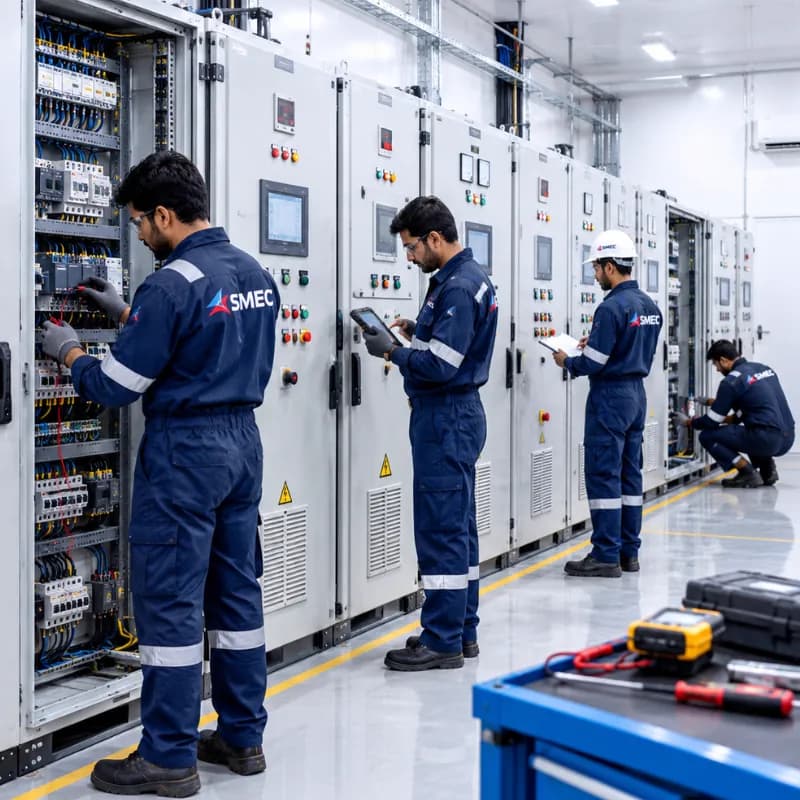
On a recent Middle East process-industry project, SMEC Oil & Gas Solutions LLC engineered, integrated, and factory-tested a Plant ESD System built around a Schneider Electric Modicon M580 Safety PLC, configured to SIL3, in a redundant Hot Standby architecture, supervised by redundant AVEVA SCADA. Here's what that actually involved, and why each piece of it matters.
What an ESD System Has to Prove - Not Just Do
A safety system doesn't pass FAT by powering up and communicating. It passes by demonstrating that the complete chain behaves correctly, end to end:
Field condition → safety input → ESD logic → Cause & Effect → output action → safe response.
A single incorrect signal mapping, interlock, or Cause & Effect relationship can change the system's actual response to a real hazard , which is why FAT for a safety system has to validate the functional chain, not just individual hardware components in isolation.
The Safety Controller
At the core of the architecture sits the Modicon M580 Safety PLC, configured for the project's SIL3 application. This layer manages ESD logic, shutdown sequences, permissives, interlocks, and defined safe-state actions. The platform reads safety inputs, executes application logic, runs diagnostics, and applies that logic to safety outputs , and when it detects an error, it drives the affected portion of the system to its defined safe state, rather than an undefined one.
Redundancy: A Question, Not a Hardware Spec
Hot Standby redundancy means the primary controller executes the application while a synchronized standby controller stands ready to take over. The engineering question FAT has to answer isn't "are both PLCs running?" It's: what happens to the control and safety function when the primary path is actually lost? That's the difference between redundancy as a spec sheet line item and redundancy as a proven operational behavior.
The same logic applies at the supervisory layer. AVEVA SCADA was implemented with redundancy specifically to preserve operator visibility , system status, alarms, event data , under the same failure conditions the PLC layer is designed to survive. For a safety-critical application, redundancy has to be validated across the whole system, not just at the controller.
Cause & Effect: Where Safety Philosophy Becomes Executable Logic
The Cause & Effect Matrix defines the relationship between a specific initiating condition and the plant response that must follow it. During FAT, each applicable cause was simulated and traced through five checkpoints: was the correct input recognized, did the correct logic execute, were the required interlocks applied, were the correct outputs commanded, and were alarms and status correctly represented to the operator. That's not I/O checking. That's functional validation of the engineered shutdown philosophy itself.
I/O Traceability and Network Redundancy
Every safety function depends on its signal path. FAT verified input and output signals, I/O mapping, application logic, interlocks, and functional responses , establishing traceability across input → logic → action → response, since a correctly programmed PLC is only one link in that chain. Communication and network redundancy were validated on the same principle: a redundant controller architecture is incomplete if the network connecting it becomes the single point of failure.
Why This Happens Before Site, Not During
The worst time to discover an ESD logic error is when the plant actually needs the ESD to work. Factory Acceptance Testing moves that discovery into a controlled environment , before the pressures of site commissioning and live plant operation are in play. For a safety system, FAT isn't the final inspection of a panel. It's the point where engineered intent has to become demonstrated functionality.
FAQ
- What is a Plant Emergency Shutdown (ESD) System? A dedicated safety system designed to bring an industrial process to a predefined safe state in response to abnormal or hazardous conditions, independent of the plant's standard control system.
- What does SIL3 mean in this context? SIL3 (Safety Integrity Level 3) is a IEC 61508/61511 classification indicating a high level of risk reduction required from the safety function, driving the design, testing, and validation rigor applied to the system.
- Why is Hot Standby redundancy used in ESD architecture? Hot Standby keeps a synchronized secondary controller ready to assume control if the primary path fails, maintaining the safety function's availability rather than accepting a single point of failure.
- What is a Cause & Effect Matrix? A structured document mapping each initiating condition (cause) to its required plant response (effect), which becomes the executable logic tested during FAT.
- Why does FAT matter for a safety system specifically? Because a safety system's value is only proven under conditions it may never encounter until it's needed , FAT is the only practical opportunity to validate that behavior before the system is relied upon in the field.
SMEC Oil & Gas Solutions LLC
supports Oil & Gas, petrochemical, and process-industry projects across the Middle East with engineering and lifecycle capability across Emergency Shutdown Systems, Safety PLCs, PLC/SCADA integration, Fire & Gas systems, Cause & Effect implementation, control panel engineering, FAT/SAT, commissioning, and brownfield control-system migration.
If you're scoping a new ESD system, facing an ageing safety PLC, or modernizing a brownfield plant's shutdown architecture, we're glad to look at the system architecture, safety requirement, and existing I/O list with you.
📧 info@smecong.com | 📞 +971 502491903