
Four diesel generators. Several hundred kilowatts of continuous load. Twenty-four-hour drilling operations. Thousands of litres of diesel burned every single day.
Ask the operator running that site one question: does anyone know, right now, which engine is burning more fuel than it should?
In most oilfields today, nobody can answer that in real time. Not because the data doesn't exist somewhere , it does. It exists in the wrong place, at the wrong frequency, in a form nobody can act on fast enough.
That gap , between data that exists and intelligence that's usable , is the actual subject of this article.
A four-engine fuel and power monitoring deployment is the vehicle. The engineering challenge underneath it is much larger, and it applies to every operator still running critical rotating and combustion assets on manual logs, hour meters, and monthly reconciliation.
It's worth being precise about what “real time” actually buys an operator, because the phrase gets used loosely. It doesn't mean a prettier dashboard.
It means the difference between discovering an overloaded engine after it has already shortened its own service life, and catching the loading trend three weeks before that damage occurs , while there's still a maintenance window, a spare part lead time, and a cost, that are all still manageable.
The economics of that gap, multiplied across a fleet and a field life measured in decades, is why this has stopped being a nice-to-have conversation.
Picture a mid-size drilling site: four diesel generators supplying continuous power to the rig, the mud pumps, the camp, and auxiliary systems. It is, in engineering terms, an unremarkable setup , the kind operating on thousands of sites worldwide right now.
Now ask the operational questions that actually determine cost and uptime:
- Which engine is consuming more fuel per kilowatt-hour delivered than the other three?
- Which one is running consistently above its efficient loading band, quietly shortening its own service life?
- Which one has been idling for hours against a manual log that says it's “on duty”?
- Which one's vibration, temperature, and oil pressure trend lines are already telling a story that won't become an alarm for another three weeks?
On the overwhelming majority of active oilfield sites, none of those questions have a real-time answer.
They have an answer that arrives in a shift-end report, or a monthly fuel reconciliation, or ,worst case , an unplanned shutdown. The information exists. The intelligence doesn't, because nobody has connected the data to a decision fast enough for it to matter.
THE CORE PROBLEM
It isn't that oilfields lack data. It's that the data arrives too late, too aggregated, and too disconnected from the person who needs to act on it.
Manual log sheets, shift reports, monthly fuel reconciliation, and reactive maintenance were not bad engineering decisions.
Twenty years ago, they were close to the only practical option , sensors were expensive, connectivity was unreliable, and the computing power to make sense of continuous time-series data at the edge simply didn't exist at a cost that made sense for a diesel generator fleet.
What's changed isn't the argument for real-time monitoring. That argument was always true. What's changed is the cost of ignoring it.
Fuel is a larger share of operating cost than it was two decades ago. Engines and control systems have become more complex, with more failure modes that a shift log was never designed to catch. And the operators competing hardest on cost per barrel are the ones who've already closed this gap , which means running a fleet on monthly reconciliation isn't a neutral choice anymore. It's a competitive one.
The specific weaknesses are structural, not incidental:
- A monthly fuel reconciliation cannot tell you which engine, on which day, burned more than its share , by the time the number is assembled, the operating conditions that caused it are long gone.
- A shift report captures what an operator noticed, not what the machine was actually doing at 3 a.m.
- Reactive maintenance, by definition, only ever responds after the failure mode has already progressed far enough to be visible without instrumentation , which is usually much later than an engineer would like.
There's also a workforce dimension to this that rarely makes it into the technology conversation.
Manual monitoring depends on an experienced operator noticing a subtle change , a sound, a vibration, a fuel delivery frequency that feels slightly off , and that kind of tacit knowledge is exactly what's becoming scarcer as experienced field crews retire and rotate faster than they once did.
A monitoring system doesn't replace that judgment. But it does something manual monitoring structurally cannot: it makes the same baseline data available consistently, regardless of who's on shift , a form of risk reduction that has nothing to do with sophistication and everything to do with continuity.
This shift isn't a prediction. It's already underway, and the capital flows confirm it.
The International Energy Agency has tracked global energy sector capital flows climbing toward roughly USD 3.3 trillion by the end of 2026 , a scale of investment that has made digital-first operating strategies a baseline expectation rather than a differentiator for companies competing on cost.
Rystad Energy's analysis puts a specific number on the prize: digital technology adoption across drilling optimization, predictive maintenance, and related applications could save the oil and gas sector an estimated USD 320 billion by 2030.
Boston Consulting Group's research goes further, estimating that full AI adoption across operations can deliver a 30 to 70 percent EBIT uplift within five years for companies that get the deployment right , a wide range that itself says something important: the technology's ceiling is high, but the gap between doing it well and doing it badly is enormous.
Independently measured downtime data backs the direction, if not yet the full scale of the promise. Siemens' Senseye-based True Cost of Downtime research tracked average monthly downtime among large manufacturers, oil and gas included, falling from 39 hours in 2019 to 27 hours in 2024, with incident frequency dropping from 42 to 25 over the same period , a real, measured improvement, concentrated specifically in rotating equipment and electric drives, the same asset class a diesel generator fleet belongs to.
The Middle East Is Setting the Pace
The Middle East is no longer following the digital transformation of oil and gas—it is helping define it.
Faced with the dual challenge of maximizing production while improving efficiency, reliability and sustainability, leading national oil companies are making significant investments in Artificial Intelligence, Industrial IoT and predictive operations.
ADNOC has emerged as one of the industry's most aggressive adopters of digital technologies. Through large-scale investments in AI-powered production optimization, predictive maintenance, autonomous inspection and well digitalization, the company reported approximately USD 500 million in AI-generated value while committing USD 920 million towards expanding AI-enabled digitalization across more than 2,000 wells.
The company has also partnered with Honeywell on one of the world's largest predictive maintenance deployments for the oil and gas sector, recognizing that even a single day of unplanned production loss can translate into millions of dollars in lost revenue.
Saudi Aramco has followed a similarly ambitious path. As part of its enterprise-wide digital transformation programme, the company has identified 442 AI use cases, with more than 200 already deployed across reservoir engineering, drilling automation, facility optimization and predictive maintenance.
These investments are not technology demonstrations.
They are strategic engineering decisions backed by operators managing some of the world's largest and most complex hydrocarbon assets.
India Is Moving in the Same Direction
The transition toward intelligent operations is equally visible across India's energy sector.
As India's upstream assets mature and production efficiency becomes increasingly important, operators are accelerating investments in digital infrastructure, predictive maintenance and connected operations.
ONGC, India's largest exploration and production company, continues advancing its digital oilfield strategy through integrated production surveillance, remote operations, predictive asset management and AI-enabled production optimization across both offshore and onshore assets.
Similarly, Oil India Limited (OIL) has expanded its focus on IoT-enabled field monitoring, intelligent production systems and data-driven reservoir management to improve operational performance across mature producing fields.
Digitalization is also reshaping India's downstream sector.
Companies including Indian Oil Corporation (IOCL), Bharat Petroleum Corporation Limited (BPCL) and HPCL are implementing connected refinery initiatives involving predictive maintenance, AI-assisted inspection, centralized asset performance management and advanced operational analytics.
While each organization follows its own digital roadmap, the underlying objective is remarkably consistent:
Moving from periodic reporting to continuous operational intelligence.
An Industry-Wide Shift
This transformation extends well beyond operators themselves.
Global technology providers and oilfield service companies including SLB, Baker Hughes and Honeywell continue expanding dedicated digital operations, AI and industrial analytics businesses to support the industry's growing demand for intelligent asset management.
Independent technical research supports this direction.
The Society of Petroleum Engineers (SPE) has published peer-reviewed case studies demonstrating the practical application of AI-driven predictive maintenance and condition monitoring across upstream operations. The conversation has moved well beyond vendor marketing—today it is supported by documented field experience and independent technical evaluation.
For operators evaluating digital transformation initiatives, the fundamental question is no longer whether these technologies work.
Field deployments around the world have already demonstrated that they do.
The real differentiator now lies in implementation quality.
The greatest value is created not simply by installing sensors or deploying dashboards, but by engineering an operational intelligence platform that combines reliable field instrumentation, robust analytics and practical engineering workflows—delivering insights that maintenance teams and operations personnel can act upon before small deviations become costly failures.
A Field-Proven Offshore Deployment
While the principles discussed throughout this article apply broadly across modern oilfield operations, they have also been validated through a real offshore deployment.
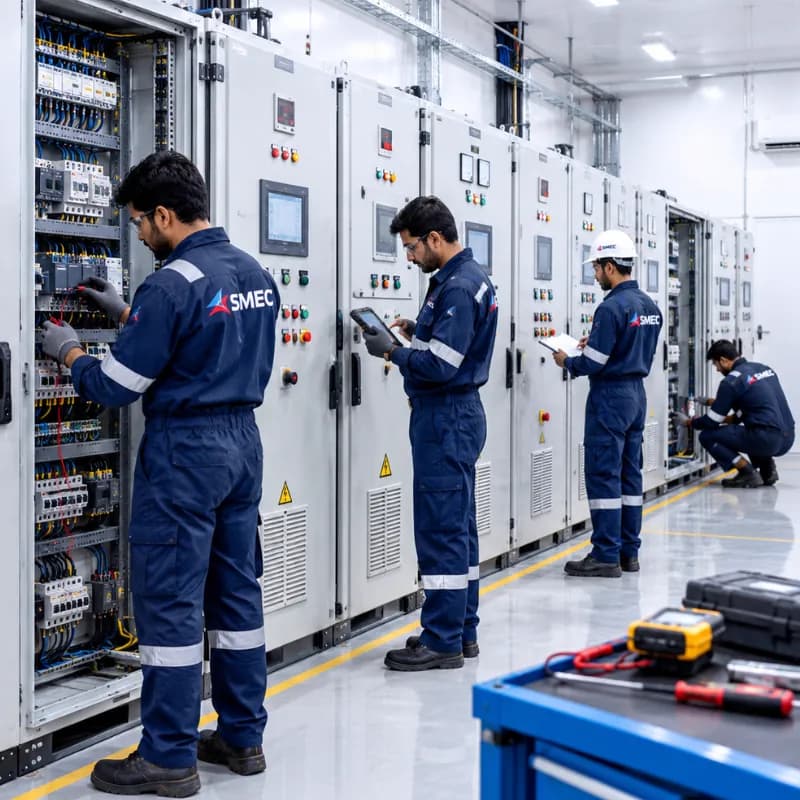
SMEC implemented its real-time engine monitoring architecture across a major offshore drilling fleet, integrating directly with the existing brownfield infrastructure without interrupting production or modifying the installed fuel piping.
Rather than relying on estimated fuel consumption or manual reconciliation, the solution continuously measures both fuel supply and return flow for each engine using clamp-on ultrasonic flowmeters, providing highly accurate real-time measurements while avoiding intrusive installation.
During commissioning and subsequent operational validation, the system achieved measurement accuracy of up to 99%, verified through field testing and confirmed during client operations.
The project established continuous visibility into critical operating parameters, including:
- Fuel consumption for each individual engine
- Daily fuel consumption trends
- Engine running hours
- Power generated by each engine
- Fuel efficiency relative to electrical output
- Historical operating trends
Unlike conventional reporting systems, every calculation is derived directly from measured field data rather than manual estimation, providing operators with continuous operational visibility while maintaining uninterrupted production.
Designed for Brownfield Oilfields
One of the defining engineering requirements was that the deployment had to integrate with an operating asset.
Replacing existing engine controls, modifying fuel piping or introducing extended shutdowns was not commercially viable.
Instead, the architecture was designed around a brownfield-first philosophy:
- Non-intrusive clamp-on instrumentation
- Integration with existing engine and power systems
- Minimal production interruption
- Open architecture for future expansion
- Scalable deployment across multiple engines and facilities
This allowed the operator to introduce real-time operational intelligence without altering proven engine control philosophies or existing process infrastructure.
Beyond Fuel Monitoring
As operational requirements evolved, the same architecture was expanded beyond engine fuel measurement.
The platform now supports additional operational parameters including:
- Water production monitoring
- Water consumption monitoring
- Historical trend analysis
- Cloud-based dashboards
- Remote asset visibility
- Centralized performance reporting
Documented calibration procedures and periodic verification remain part of the engineering lifecycle, ensuring long-term measurement integrity rather than treating commissioning as a one-time activity.
From Measurements to Decisions
The value of the deployment was never the flowmeter itself.
It was the ability to transform continuous field measurements into engineering decisions.
Recommended by LinkedIn
Instead of waiting for monthly fuel reports, engineering teams can continuously evaluate:
- Which engine is operating most efficiently
- Whether electrical load distribution is balanced
- Whether operating trends indicate developing performance issues
- Whether maintenance should be driven by actual equipment condition rather than fixed intervals
In other words, the deployment shifts monitoring from recording what happened to understanding what is happening—and identifying what is likely to happen next.
It's tempting to treat this as a fuel-metering problem — put a flowmeter on each engine, and the visibility gap closes.
It doesn't, because fuel consumption in isolation answers only one question, and operators need to answer several at once:
- Fuel tells you how much was burned. It doesn't tell you why.
- Power and generator loading tell you whether the engine is working inside its efficient band or being pushed past it.
- Power factor tells you whether the electrical system is drawing more current than the useful work it's doing.
- Engine temperature, cooling performance, and oil pressure tell you how the machine is coping with that load, mechanically.
- Battery health and runtime tell you whether the standby and starting systems will actually work when they're called on.
- Idle time and load balancing tell you whether the fleet as a whole is being run efficiently, not just each engine individually.
- NOx, SOx, and CO2 data are no longer optional line items — they're compliance and ESG reporting requirements in their own right, in the GCC as much as anywhere else.
None of these parameters, read alone, is operational intelligence. Together, correlated against each other and against historical baselines, they are.
A fuel spike that coincides with a loading spike and a temperature climb is a very different engineering situation than the same fuel spike occurring on an engine running well within its rated band — and only a system reading all of these parameters together can tell the difference in real time, rather than after the fact.
Consider a concrete version of that scenario. An engine's fuel consumption rises 8 percent over a week.
Read in isolation, that number could mean almost anything — a genuine efficiency problem, a colder night shift drawing more auxiliary load, or simply normal variation.
Correlated against loading data, oil pressure, and exhaust temperature from the same period, the same 8 percent tells a specific story: whether it's a fuel system issue, a mechanical degradation issue, or an operational one.
That correlation is the actual product. A flowmeter on its own is a component. A flowmeter whose output is automatically reconciled against five other live parameters is operational intelligence — and the difference between those two things is almost entirely an engineering and systems-integration problem, not a sensor-cost problem.
A four-engine deployment of this kind follows a consistent architecture, regardless of vendor, because the underlying engineering problem — getting a signal from a rotating machine to a decision-maker's screen, reliably, in near real time — has a small number of workable solutions.
- Field sensors — flowmeters, power meters, temperature and pressure transmitters — installed on each engine
- PLC and edge gateway — aggregating and pre-processing signals at the site, tolerant of intermittent connectivity
- Industrial database — structured historian storage for high-frequency time-series data
- Engineering analytics layer — converting raw signals into fuel efficiency, loading, and health indicators
- Cloud and mobile dashboards — giving operations, maintenance, and management their own view of the same data
- Predictive alerts — surfaced to the people who can act on them, not buried in a report nobody reads
The engineering discipline in this architecture isn't in any single layer — it's in the handoffs between them:
- A flowmeter that's accurate but poorly integrated into the PLC produces noise, not data.
- An edge gateway that buffers correctly during a connectivity drop preserves the historical record; one that doesn't creates gaps that undermine every predictive model built on top of it.
- A predictive alert that reaches an engineer's dashboard but never reaches the maintenance work-order system doesn't actually change anything — it's the same unread report, just faster.
ENGINEERING NOTE
The value of this architecture isn't the sensors. It's the discipline of the handoffs between sensor, gateway, database, analytics, and the person who acts on the output.
Most conversations about digital oilfields implicitly assume a greenfield installation — new engines, new control systems, a clean slate.
That's not the reality most operators are working with. The majority of the diesel generator fleet running critical loads across active oilfields today was commissioned years, sometimes decades, ago, on control systems and communication protocols that predate the digital oilfield conversation entirely.
Replacing an engine control system outright is expensive, and not primarily because of the hardware cost. It's expensive because of what surrounds the hardware:
- Legacy PLCs from OEMs who may no longer support the platform
- Generators and switchboards that were never designed with the new control architecture in mind
- Shutdown windows measured in days rather than the weeks a full replacement realistically requires
- Communication protocols — some proprietary, some simply undocumented after years of field modifications — that a new system has to be built to understand rather than replace
This is precisely why brownfield-friendly digitalization has become more commercially valuable than wholesale replacement for the majority of operators.
A retrofit-capable monitoring and intelligence layer doesn't require touching the existing control logic that already works. It reads what the existing system already knows — engine parameters, power data, control signals — through the protocols that are already in place, and adds the analytics layer on top, rather than underneath.
The engineering skill this demands is different from a greenfield build: it's less about specifying new equipment and more about understanding, protocol by protocol, what a fifteen-year-old PLC is actually willing to tell you, and how to get that data out without disturbing a control loop that's currently keeping a rig running.
Operators who understand this distinction increasingly favour partners who can demonstrate brownfield integration experience specifically, rather than general automation capability. The two are related, but they are not the same skill.
There's a second brownfield complication worth naming directly: most active oilfields don't run a single OEM's equipment across their whole fleet.
One generator might be from one manufacturer, the switchboard from another, the PLC from a third — accumulated over years of expansions, replacements, and whichever vendor had the shortest lead time at the time.
A digitalization layer that assumes a homogeneous OEM environment breaks the moment it meets that reality. The engineering requirement is an open architecture that can speak to multiple protocols and multiple vendor ecosystems simultaneously, without forcing a standardization project as a precondition.
For most operators, that standardization project is exactly the multi-year, multi-million-dollar undertaking the brownfield approach exists to avoid in the first place.
Artificial intelligence in this context is not a dashboard feature. Applied correctly, it changes five specific decisions an operator makes:
- When to schedule maintenance
- How to optimize fuel consumption across a fleet rather than engine by engine
- How to balance load automatically instead of by manual switching
- How early a failure can be predicted before it becomes an outage
- Over a longer horizon, how an engine's real-world performance compares to its digital twin — closing the loop between design assumptions and operating reality
Maintenance scheduling is the clearest near-term case. Instead of servicing every engine on the same calendar interval regardless of actual condition, a model trained on historical failure patterns and live sensor trends can flag the specific engine, and the specific component, that's genuinely approaching a failure mode — while leaving the other three alone.
That's the difference between predictive maintenance and preventive maintenance, and the ROI data increasingly bears out the distinction: industry-reported deployments across upstream, midstream, and downstream applications have documented reductions in unplanned failures in the range of 40 to 60 percent where predictive models are properly integrated into the maintenance workflow, rather than left as a standalone analytics exercise.
Fuel optimization and load balancing follow the same logic applied across the fleet rather than to a single machine — an AI model can recommend, or in more mature deployments automatically execute, load-sharing adjustments that keep every engine closer to its efficient operating band, rather than relying on an operator's manual judgment call under time pressure.
Digital twin technology represents the furthest end of this trajectory — a live virtual model of the engine fleet, continuously reconciled against real sensor data, that lets engineers simulate the effect of a load change or a maintenance deferral before committing to it in the physical world.
Adoption is real but still early: industry surveys put digital twin usage at roughly half of oil and gas companies, with a meaningful share of those same companies reporting that the technology hasn't yet delivered on its promised return.
That gap between adoption and satisfaction is not an argument against the technology. It's an argument for treating it as an engineering discipline that has to be implemented well, not a feature that works simply because it's switched on.
Everything described above is an industry-wide engineering challenge, not a description of any single product.
SMEC's answer to it is NexWave — built specifically as an engineering platform, not a monitoring app, because the team that built it spent its career in automation, electrical, and instrumentation engineering on oilfield assets before it wrote a line of software.
That distinction matters more than it sounds. A monitoring app is built by software engineers who add domain knowledge afterward. NexWave was built the other way around — by engineers who understood generator loading, protection coordination, and brownfield PLC integration first, and built the software layer to serve that understanding, not to abstract it away.
What NexWave Covers
- Real-time fuel monitoring and fuel flow measurement, per engine, not fleet-averaged
- Power generation intelligence, including generator loading and power factor tracking
- Engine performance analytics — temperature, cooling, oil pressure, and battery health in one view
- Runtime and idle-time monitoring, so idle hours stop hiding inside “on duty” logs
- An asset health index that consolidates multiple signals into a single, trackable indicator per engine
- Maintenance indicators and predictive alerts, built to reach a work-order system, not just a screen
- NOx, SOx, and CO2 monitoring, structured for ESG and regulatory reporting rather than bolted on afterward
- Historical analytics for trend analysis and post-incident investigation
- Brownfield integration as a first-class capability, with support for major PLC platforms and communication protocols already in the field
- Open architecture, so the platform extends rather than locks an operator into a single OEM ecosystem
- Cloud and mobile dashboards, giving operations, maintenance, and management their own relevant view of the same underlying data
- AI-ready operational intelligence — the data foundation for predictive maintenance and digital twin work, not a replacement for the engineering judgment behind it
The four-engine deployment that opened this article is one implementation of this architecture.
Flowmeters, power meters, and temperature sensors report through a PLC and edge gateway into an industrial database, with engineering analytics turning that stream into fuel efficiency, loading, and health indicators an operator can actually act on — surfaced through cloud and mobile dashboards with predictive alerts built in.
The engineering discipline described throughout this article — protocol-level brownfield integration, correlated multi-parameter analysis rather than single-metric monitoring, and alerts designed to reach a decision rather than a dashboard — is the discipline NexWave was built around.
Conclusion — The Question That Actually Matters
The future of oilfield operations will not be defined by how many engines an operator owns.
It will be defined by how intelligently those engines are monitored, optimized, and maintained — and increasingly, by whether an operator's engineering partner understands brownfield reality as deeply as they understand greenfield design.
Engineering decisions across this industry are becoming data-driven, not because it's fashionable, but because the operators who made that shift first are now running lower lifting costs than the ones who haven't.
The capital flows, the documented downtime reductions, and the scale of Middle East investment in this space all point the same direction.
The question worth asking is no longer how much fuel an operation consumed last month. It's a harder, more immediate question, and it's the one this entire architecture exists to answer:
What is every engine trying to tell us, right now?
From Monitoring to Engineering Intelligence
The future of oilfield operations will not be defined by how much data is collected, but by how effectively that data is transformed into operational decisions.
At SMEC, we help operators, drilling contractors and EPC companies bridge that gap through integrated Electrical, Instrumentation and Automation engineering, combined with real-time operational intelligence powered by NexWave.
Whether your objective is improving fuel efficiency, optimizing engine performance, enabling predictive maintenance or digitally modernizing existing oilfield assets, our engineering team is ready to support your journey.
Explore how SMEC NexWave can transform your oilfield operations.
📧 sales@smecong.com 📞 +91 86060 47714 🌐 www.smecong.com
Explore SMEC
SMEC – The Solution Hub is our cross-industry knowledge series covering Oil & Gas, Marine, and Industrial systems where engineering, automation, and operations intersect.
Our Ecosystem:
India :
- SMEC Automation
- SMEC Technologies (AI Intelligence Solutions)
UAE :
- SMEC MARINE SOLUTIONS LLC
- SMEC NAVSOL
- SMEC Oil & Gas Solutions LLC
Training & EduTech
- SMEClabs
- SMEC Technologies
Our Digital Hubs:
- Corporate: www.smec.in
- Energy & Industrial: www.smecoilandgas.com
- R&D & Technology: https://smecrtd.com/
- Asset Intelligence: www.ProSet360.com
Join the Conversation:
- YouTube